Bounces and delivery errors
Ce contenu n'est pas encore disponible dans votre langue.
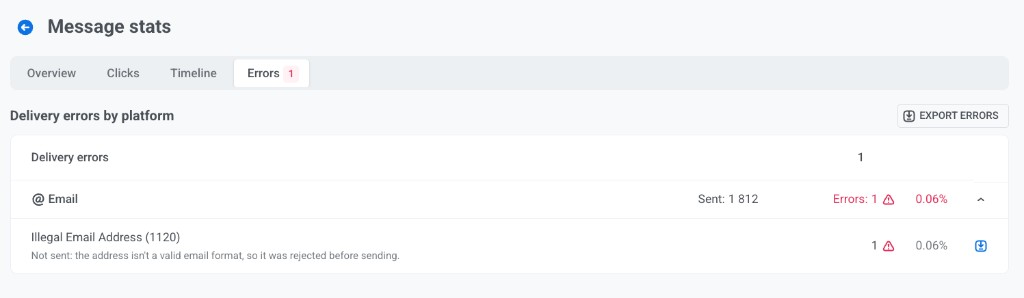
Use the Errors tab to see why this email failed for some recipients. The red badge on the tab shows the total of rejected sends plus Processing errors. To get there, open the detailed statistics of an email and click Errors.
Delivery errors by platform
Anchor link toDelivery errors by platform shows each platform (for email, @ Email) with sent count, failed count, and error rate.
- Expand a platform to see each error code, a short description, and the count.
- Click Export errors to download the full list, or use the download icon on one error row. Both exports require the Personal data permission in your role.
- For email, the Export errors file also lists bounced addresses, one row per address with its last bounce on this email. For these rows,
reasonholds the bounce reason, and thebounce_type(hardorsoft),smtp_code, andprovidercolumns at the end of the file are filled in. The button is available even when the email has bounces but no sending errors. A file for one error row doesn’t include bounces.
Bounces by reason
Anchor link toThe Bounces block groups the addresses that bounced on this email by the reason the recipient’s mail server gave. Hard and soft bounces are listed separately, the largest reason first. The block appears only when the email has at least one bounce with a reason. If the block is missing, check the error rows above.
The block shows these columns:
| Column | What it shows |
|---|---|
| Reason | The bounce reason. |
| Addresses | How many addresses got this reason. Each address counts once, by its last bounce on this email. |
| Top SMTP codes | Up to three SMTP codes behind this reason (status codes the recipient’s mail server returns, such as 5.1.1), the most common first, with the number of addresses for each. |
| Provider | The service that returned the response shown in Provider response. |
| Provider response | The response most of these addresses got. Hover it to read the full text. Recipient addresses in it are masked. |
The table below explains each reason and what to do about it.
| Reason | What it means | What to do |
|---|---|---|
| Address doesn’t exist | The recipient’s mail server says the address doesn’t exist. | Remove it from your list. Reactivating it won’t help. |
| Mailbox inactive | The mailbox is disabled. | Remove it from your list. |
| Mailbox full | The mailbox is over quota. This is usually temporary. | Nothing. The address may work again later. |
| Blocked: sender reputation | The provider limits your sending domain or IP address. | Lower the sending volume, check your complaint rate, and check SPF, DKIM, and DMARC for your sending domain. |
| Rejected as spam | The provider rejected the email as spam. | Check the content and links. |
| Delivery failed | Delivery timed out because the recipient’s server could not be reached, for example because of a connection or DNS problem. | Watch for repeat failures. |
| Other | Pushwoosh couldn’t classify the provider’s response. | Check the SMTP code and the provider response. |
The same reason can appear in both groups. For example, a full mailbox can return a hard or a soft bounce, depending on the provider. Whether Pushwoosh suppresses the address depends on the bounce type, not on the reason. See Email error types you may see.
Email error types you may see
Anchor link toThe tables below explain the bounce, complaint, and suppression names that can appear when you expand @ Email. For sender and SMTP codes, see Email errors.
Pushwoosh sent the email, but the recipient’s mail server refused it: a hard bounce, a soft bounce, a spam complaint, or an undetermined bounce. For hard bounces and complaints, Pushwoosh automatically suppresses the address so it won’t be emailed again. Soft bounces and undetermined bounces don’t suppress the address.
| Error | Description | What happens next |
|---|---|---|
| Hard Bounce General | Permanently rejected without a specific reason. | Pushwoosh adds the address to your suppression list. It won’t be emailed again. If the hard bounce rate exceeds your plan’s hard bounce rate limit, 5% by default, Pushwoosh pauses email sending in the project and checks your email database. |
| Hard Bounce Mailbox Full | The inbox is over quota and the server rejected it permanently. | Pushwoosh adds the address to your suppression list. |
| Hard Bounce Inactive Mailbox | The mailbox is closed or abandoned. | Pushwoosh adds the address to your suppression list. |
| Hard Bounce Suppressed | The receiving provider already has this address suppressed after earlier permanent failures. | Pushwoosh adds it to your suppression list as well. |
| Hard Bounce Undetermined | Permanently rejected for an unknown reason. | Pushwoosh adds the address to your suppression list. |
| Soft Bounce General | Temporarily rejected without a specific reason. | Nothing is suppressed. Pushwoosh retries on the next send. |
| Soft Bounce Attachment Rejected | The recipient’s server blocked the email because of attachment restrictions. | Nothing is suppressed. Try sending without the attachment. |
| Soft Bounce Spam | The recipient’s server flagged the email as spam. | Nothing is suppressed. Review your content and sender authentication. |
| Soft Bounce Message Too Large | The email exceeded the recipient’s size limit. | Nothing is suppressed. Reduce image sizes or simplify the template. |
| Soft Bounce Content Rejected | The recipient’s server rejected the message content. | Nothing is suppressed. Review the email for spam triggers and policy violations. |
| Soft Bounce Mailbox Full | The recipient’s inbox is full right now. | Nothing is suppressed. Delivery may succeed once space frees up. |
| Soft Bounce Undetermined | Temporarily rejected for an unknown reason. | Nothing is suppressed. Watch for repeat failures. |
| Soft Bounce Timeout | The recipient’s server took too long to respond. | Nothing is suppressed. Pushwoosh retries on the next send. |
| Complaint General | A complaint was reported for this address. | Pushwoosh unsubscribes the recipient and permanently suppresses the address. |
| Complaint Abuse | The recipient marked the email as spam. | Pushwoosh unsubscribes the recipient and permanently suppresses the address. Complaints hurt sender reputation the most. Keep the complaint rate below 0.1% of sent emails, the level that mailbox providers such as Gmail expect. If it reaches your plan’s complaint rate limit, 1% by default, Pushwoosh pauses email sending in the project and asks you to check email contents. |
| Bounce Undetermined | The server accepted the email but never confirmed delivery. The outcome is unknown. | No address is suppressed. Monitor for repeat occurrences. |
Pushwoosh didn’t send these emails at all. The address was already on your suppression list from an earlier bounce, complaint, or unsubscribe, or the address itself is invalid.
| Error | Description |
|---|---|
| Illegal email address | The address isn’t a valid email format, so it was rejected before sending. |
| Email is bounced | The address is suppressed after an earlier permanent bounce. |
| Email complaint | The address is suppressed after an earlier spam complaint. |
| Email is unsubscribed | The recipient opted out of marketing emails. Transactional emails are still delivered to this address. |
To learn how to prevent these issues and improve deliverability, see Email deliverability best practices.