Smart Content
เนื้อหานี้ยังไม่มีในภาษาของคุณ
The Smart Content element sends a push notification to users, just like the Push element. Instead of a single preset, you provide several content variants. Optimization runs continuously on live data, without manually restarting the test or keeping a fixed traffic split. Pushwoosh shifts more traffic toward the variant that gets opened most.
Add the Smart Content element after the event or condition that should trigger it, then configure the element.
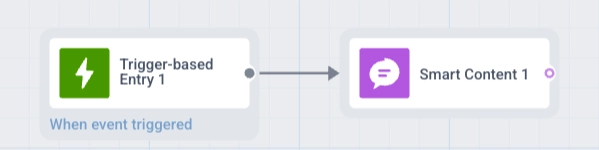
Add content variants
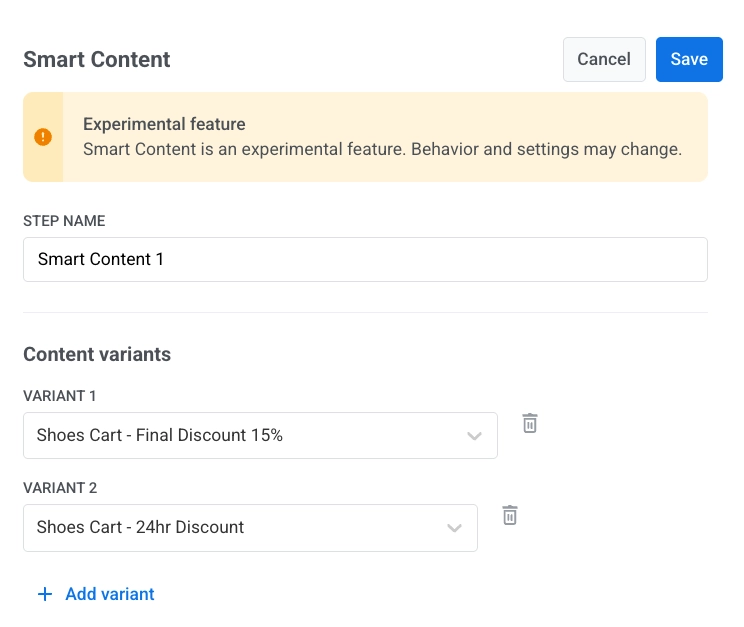
Anchor link to- Double-click the Smart Content element to open its settings.
- In Content variants, select at least two different push presets.
- Click Add variant to include more presets. There is no upper limit.
Choose success metric
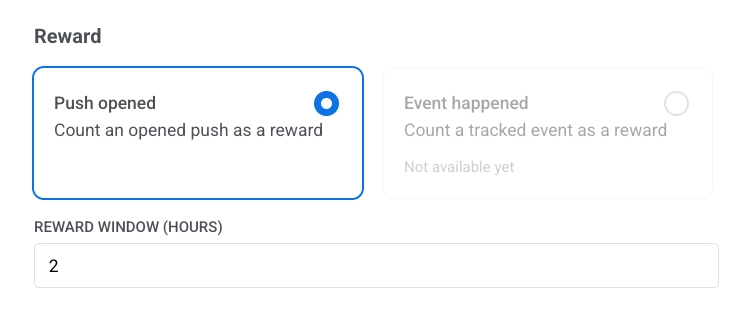
Anchor link toIn the Reward section, pick what counts as a win for a variant:
- Push opened: a variant wins a send when the user opens that push.
- Event happened: pick a custom event as the success signal instead of opens. This option is coming soon.
Set Reward window to define how many hours Pushwoosh waits after sending before checking whether the push was opened. The default is 2 hours.
Set message type
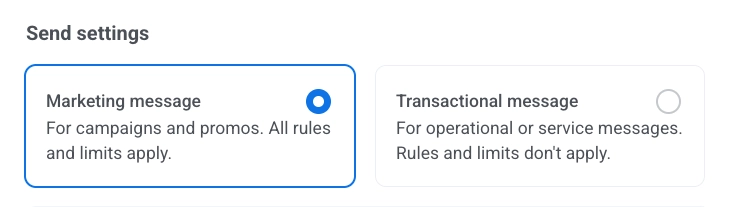
Anchor link toChoose Marketing message or Transactional message:
- Marketing message: For campaigns and promos. All rules and limits apply. Respects: opt-outs, frequency capping, and the silence period. Excludes: the global control group users.
- Transactional message: For operational or service messages. Rules and limits don’t apply. Bypasses: opt-outs, frequency capping, and the silence period. Sent to: the global control group users.
Learn how message type affects delivery.
Configure message delivery settings
Anchor link toSet frequency capping
Anchor link toUse Frequency capping to limit how often users receive push messages, preventing over-messaging and reducing churn. In the Smart Content element settings, choose one of the following options:
-
Use Global frequency capping settings
Apply the project-wide limits configured in your Global frequency capping settings.
For example, if the global limit is set to 3 messages in 9 days, additional messages exceeding this limit will be skipped.
-
Ignore Global frequency capping
The user will receive this message even if they’ve exceeded the channel’s message limits. Use this option with caution to avoid over-messaging.
-
Use custom frequency capping
Set a custom message limit for this message. If the user exceeds this custom cap, the message will be skipped, and the user will proceed to the next step.
Important: Custom frequency capping does not isolate the message from Global frequency capping. All messages sent on the same channel, including those from other journeys or campaigns, are still counted toward the global cap. If the user has already received 3 push messages this week from other sources, this message may still be blocked, even if the custom capping would allow it. Learn more
Set send rate limits
Anchor link toThe Send rate setting controls how quickly messages are delivered to your audience. Adjusting the send rate helps you manage delivery speed, prevent backend overload, and improve overall deliverability.
Choose one of the following options:
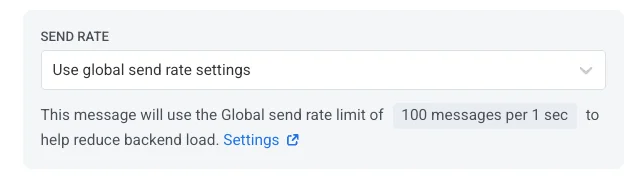
- Use global send rate settings Applies the send rate limits configured in your project’s message delivery settings. If no limits are set, all messages will be sent immediately. Use this option when you want delivery speed to follow your project’s default rules. Learn more about global send rate limits
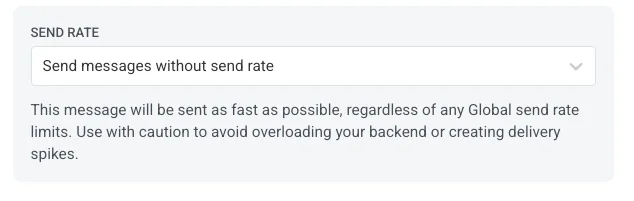
- Send messages without send rate Sends messages as fast as possible, ignoring any global send rate limits. Use with caution to avoid overloading your backend or creating delivery spikes.
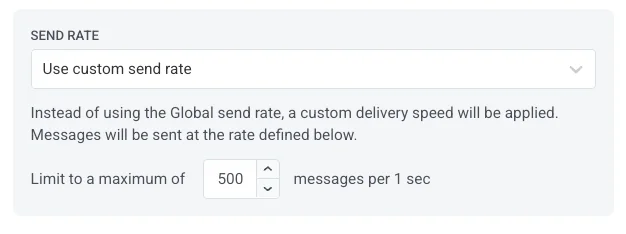
- Use custom send rate Overrides the global send rate for this message only. Allows you to specify the number of messages sent per minute, giving you full control over delivery speed. Messages will be sent at the custom rate you define in the message element.
When you finish configuring the Smart Content element, click Save.
How Smart Content picks a variant
Anchor link toSmart Content doesn’t alternate between variants evenly or run a fixed 50/50 split like A/B/n split. Instead, it continuously watches which variant gets opened more often and gradually sends that variant to a larger share of users. It still sends the other variants often enough to keep learning from real data.
A few things to know about how it behaves:
- It takes some time and volume for a clear leader to emerge. Early on, variants are sent close to evenly.
- Pushwoosh avoids sending the same variant to the same user twice in a row, so people don’t get the exact same message repeatedly.
- Selection is based on the overall performance of each variant across all users in the journey, not on an individual user’s preferences.
Even after a variant is confirmed as the winner, Smart Content keeps running. Unlike an A/B/n split, it doesn’t lock in the winner and route all traffic to it. The winning variant keeps getting the largest share of sends, while the others still receive a smaller share so Pushwoosh can keep learning. If performance shifts over time, Smart Content adapts and can move traffic to a new leader.
Review results
Anchor link toAfter you save the element and launch the journey, open the Smart Content element’s statistics panel to see how your variants are performing.
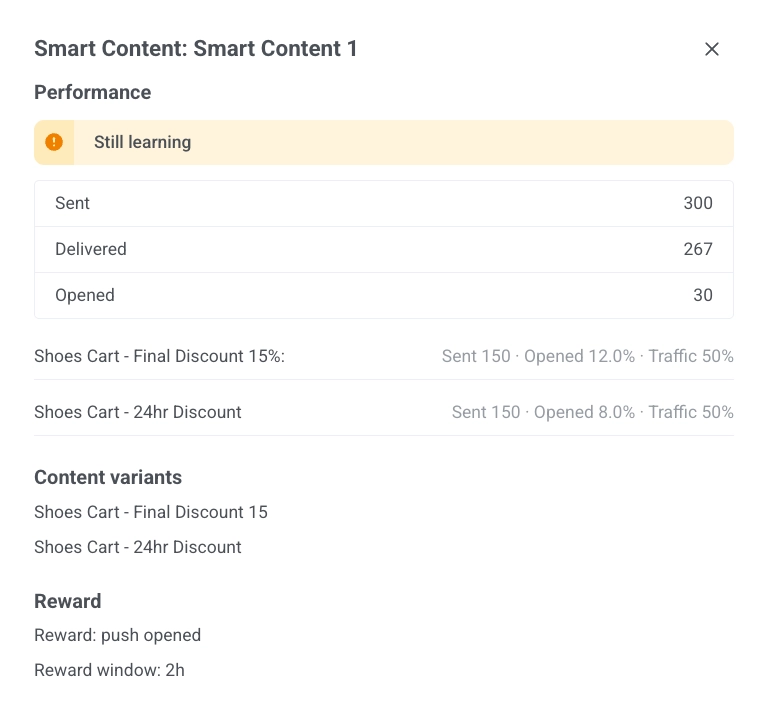
A banner at the top shows the current status of the experiment:
- Not enough data yet: Smart Content hasn’t collected enough sends to say anything meaningful.
- Still learning: there’s data, but no variant is a clear, statistically significant leader yet.
- Significant leader: one variant is confirmed to outperform the others. It’s marked with a Winner badge.
For each variant, you’ll see:
- Sent: how many times this variant was sent.
- Opened: the share of sends that were opened.
- Traffic: the current share of new sends going to this variant.