How to read the Errors tab
When some recipients didn’t get your message, the Errors tab shows why. It lists the failed sends of the message, so you can look up what each error means and fix it, or export the failed sends.
To open the tab, go to the Message stats page of the message and click Errors, next to Overview and Timeline.
What the Errors tab shows
Anchor link toThe tab shows the failed sends of one channel. If a message went out on several channels, the tab shows the channel you selected above it.
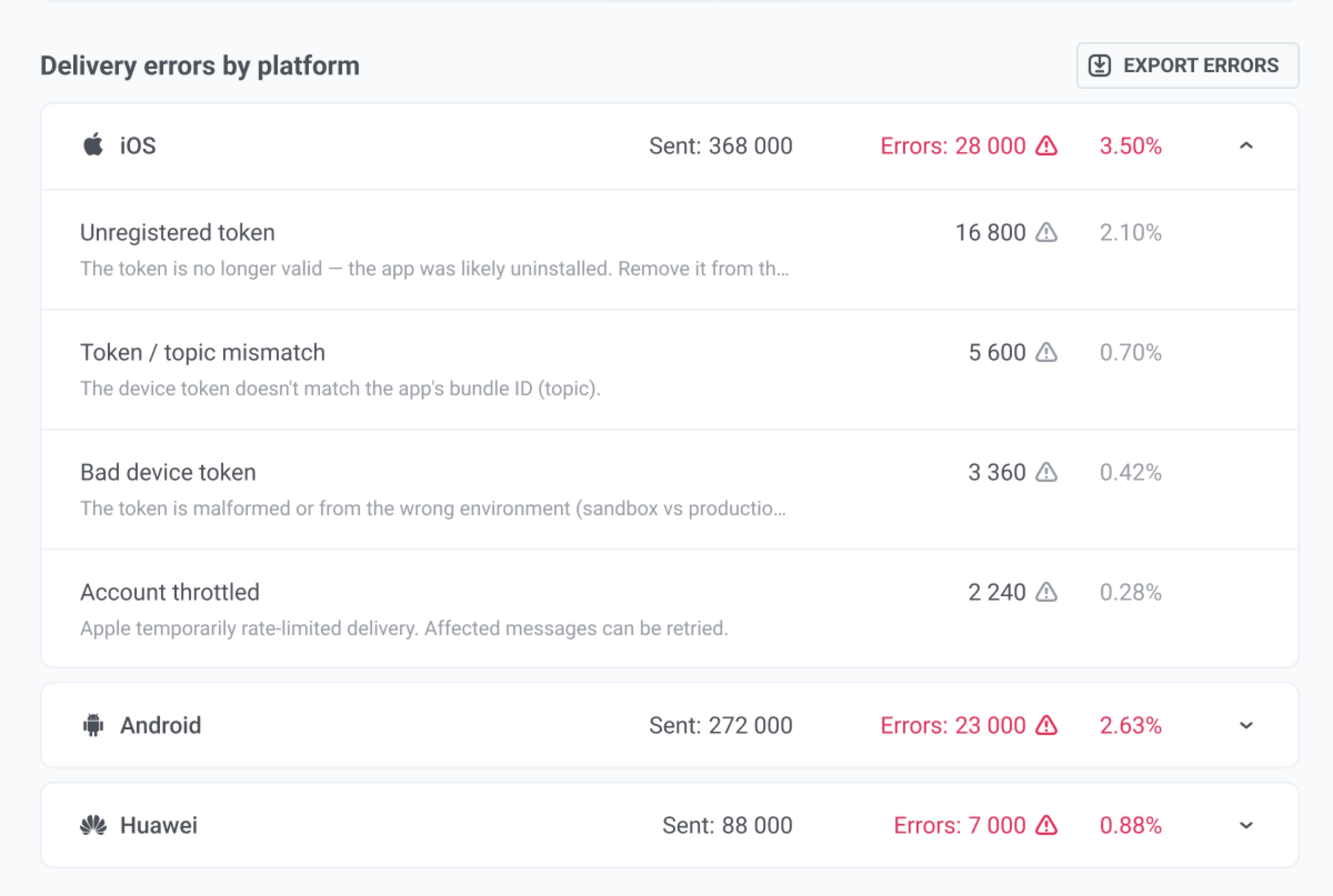
Failed sends are grouped by platform, for example iOS, Android, or Email. Click a platform to collapse or expand its errors. Each group has these parts:
- Platform row: how many messages were sent on this platform, how many failed, and what share of the channel’s eligible audience they are.
- Error rows: one row per error, shown as its name and code, for example Invalid To Phone Number (1001), with a short description under it. Each row has its own count and its share of the same audience.
The red badge on the Errors tab is the number of failed sends in the selected channel, Processing errors included. Without failed sends there is no badge.
When the tab is empty
Anchor link toThe tab shows No delivery errors for this message in two cases:
- Nothing failed. There are no errors to list.
- The message failed before it was sent (status Failed). Nothing was sent, so there is nothing to list. It doesn’t mean the message was delivered. The reason is shown on the Overview tab. See Why a message failed.
What the tab doesn’t show
Anchor link toThe tab lists only sends that failed before or while Pushwoosh handed them to the delivery platform. It doesn’t list:
- Audience exclusions. Subscribers left out on purpose, for example by frequency capping, the global control group, or an earlier unsubscribe. The Overview tab shows them in Excluded rows.
- Rejections after the delivery platform accepted the message. For example, an SMS that the carrier fails to deliver later. Such a send counts as Accepted by gateway on the Overview tab and, until delivery is confirmed, as Delivery not confirmed.
- Temporary failures that Pushwoosh retries. They aren’t recorded as errors.
Look up an error
Anchor link toTo find out what an error means and how to fix it:
- Read the name and the code in the error row. Different errors can share a code, for example Silent Hours (1041) and the WhatsApp error Template Is Paused (1041), so look up the name too.
- Look for them in Errors on every platform.
- If they aren’t there, open the page for the row’s platform under Sending errors.
- If the row has a category name instead of a code, for example Unclassified error, find it in Error categories.
Pushwoosh sorts every error into one of these categories. The tab shows a category name only for errors that have no code.
Errors on every platform
Anchor link toThese errors can appear on any platform, from push to SMS and messengers. Pushwoosh reports them before or while handing the message to the delivery platform.
| Error | What it means | What to do |
|---|---|---|
| Push Token Not Found (1007), Phone Number Not Found (1007) on SMS | The subscriber has no push token, phone number, or chat ID for this platform in the project, so Pushwoosh didn’t send the message. | Collect the contact and register it in the project. |
| Platform Is Disabled (10005) | The platform is turned off for the project. | Turn the platform on in Settings > Configure Platforms. If you don’t want to send on this platform, remove it from the message. |
| Skip Push (1011) | A placeholder had no value for this subscriber and no default value. On SMS, and for text built from a product feed, it also appears when the text was empty after placeholders were filled in. | Check the placeholders and their default values in the message or preset. |
| Unable To Compile Liquid Template (1014) | The message contains a Liquid syntax error. | Fix the Liquid template in the message or preset. |
| Silent Hours (1041) | The recipient was inside the channel’s silent hours, and the channel’s Message behavior is Do not send. It isn’t a delivery failure. | Nothing to fix. To reach these recipients, send the message without silent hours or choose Send after the silence period ends for the channel. |
| Internal Service Error (10006) | The send failed before or while Pushwoosh handed it to the delivery platform. On some platforms it also covers setup errors, see the platform’s page under Sending errors. | If it repeats, contact Pushwoosh Support. |
Error categories
Anchor link toEach category below says what went wrong and what to do.
| Category | What it means | What to do |
|---|---|---|
| Invalid or expired token | The token or email address can no longer receive messages, for example because the app was deleted or the address is invalid. | Common on large audiences. Compare with earlier sends of a similar size. Dig deeper only if the share jumps a lot. |
| No push token | The subscriber has no push token, email address, phone number, or chat ID on this platform. | For push, ask your development team to check that the app registers devices. For other channels, collect and register the contact. |
| Device not found | The device is not in your Pushwoosh audience. | Often follows segment filters or audience cleanup. Check who was targeted. |
| Platform disabled | This platform is turned off in the project, or the delivery platform’s API is disabled, for example Firebase Cloud Messaging. | Turn the platform on in app configuration, or remove it from the send. |
| Provider quota exceeded | Apple, Google, or another delivery platform limited the send, or your email sending quota is used up. | Slow down or split the send. Check with Support if it keeps happening. |
| Invalid message content | The message content was rejected (empty or invalid). | Open the preset or message text and fix empty or broken content. |
| Invalid platform configuration | App credentials for this platform are wrong or outdated (certificates, keys, and similar). | Check platform setup in the Control Panel, or ask Support / your developers to renew credentials. |
| Provider error | The delivery platform reported a problem, or the code was not recognized. | A few cases are usually fine. Many cases: contact Pushwoosh Support with the message date and Message code. |
| Processing error | Something failed in Pushwoosh’s own processing while sending. | Contact Pushwoosh Support. |
| Unclassified error | The error did not fit a known group. | Should be rare. If you see many, contact Support with the message date and Message code. |
For SMS, Viber, WhatsApp, Telegram, Facebook Messenger, Kakao, and LINE, every error the provider returns is listed under Provider error, whatever its cause, including sending limits, invalid credentials, and template problems. Provider quota exceeded and Invalid platform configuration apply only to push and email. To find out what such an error means, look up its name and code in SMS and messenger errors.
Processing errors
Anchor link toProcessing errors are failures in Pushwoosh’s own processing: building the message, handing it over, or reading the delivery platform’s reply. You see them in two places:
- The Errors tab lists them together with other errors.
- On the Overview tab, the funnel shows them in their own row, not under rejected sends.
Export errors
Anchor link toYou can export one error or all errors on the tab:
- To export recipients for one error, click the download icon next to that error.
- To export every error in one file, click Export errors.
Exporting errors requires both of these:
- The Personal data permission in your role.
- Access to message logs on your account.
If the download icon and Export errors are missing, ask your account admin or Support to check both. Rows without a code have no download icon. Use Export errors to include them.