Account settings
The Account settings section allows you to manage your login and security settings, time zone, and notification settings, and get an overview of your Pushwoosh usage metrics.
To open it:
- Click My account:
- On the Projects page, it’s the profile icon in the top-right corner.
- Inside a project, it’s the My account link at the bottom of the sidebar. In the Modern layout, it’s the profile icon at the bottom of the icon bar.
- Click your account row.
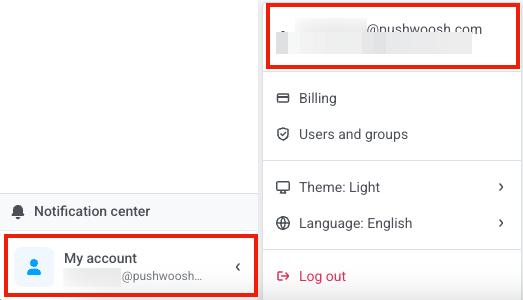
Below is a breakdown of each subsection and its functionalities.
Account settings
Anchor link toLogin and security
Anchor link toEmail login
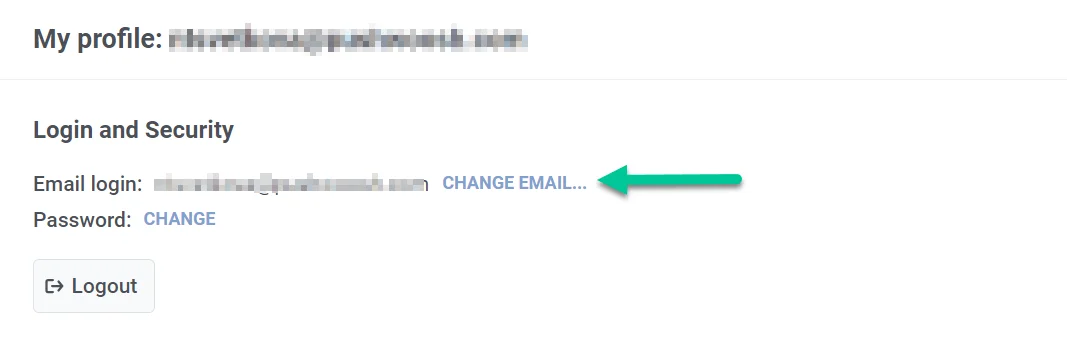
Anchor link toThe email address you registered with is displayed here. To update it, click CHANGE EMAIL.
In the pop-up window, enter the new email address you wish to use and your current password to confirm the change. Then click the Get link button.
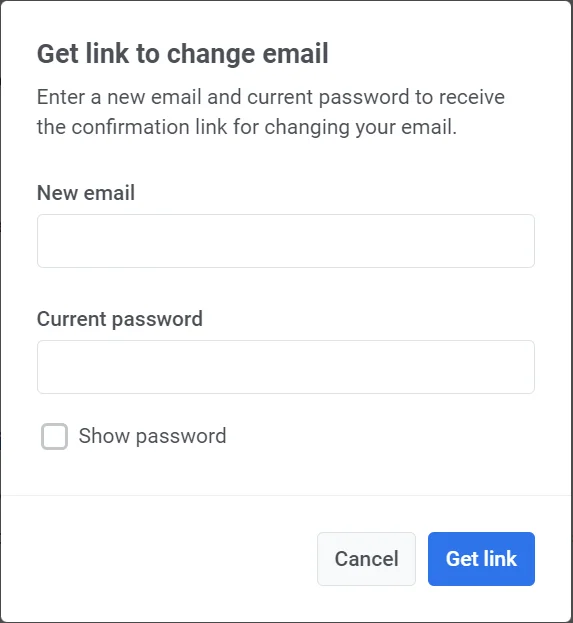
Pushwoosh emails you a link. Open it to confirm the change.
Password
Anchor link toTo change your password:
- Click CHANGE next to Password. The Password Recovery page opens.
- Click Send Password Token. Pushwoosh emails you a password recovery link.
- Open the link from the email.
- Enter the new password in New Password and Confirm Password.
- Click Save Password.
The recovery link is valid for 1 hour. If the email doesn’t arrive, click Send Password Token again: you can request up to 3 links per hour.
After the password change, all active sessions of your account are signed out, including the current one, so sign in again with the new password. Unused recovery links stop working.
If you wish to sign out of your account, you can do so by clicking on the Logout button in this section.
Two-factor authentication
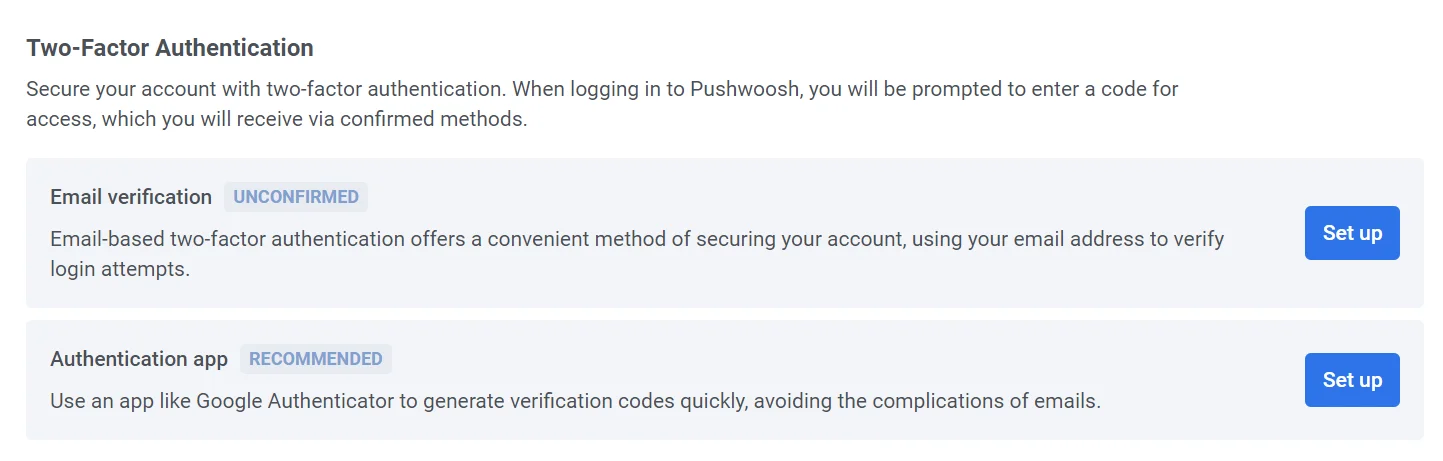
Anchor link toYou can turn on two-factor authentication (2FA) to add another layer of security to your account. Pushwoosh provides two options for two-factor authentication: email verification and an authentication app (e.g., Google Authenticator).
To enable both methods:
- Set up email verification.
- Set up the authentication app.
When you log in, you can then choose either method. If codes don’t reach you by one method, use the other as a backup.
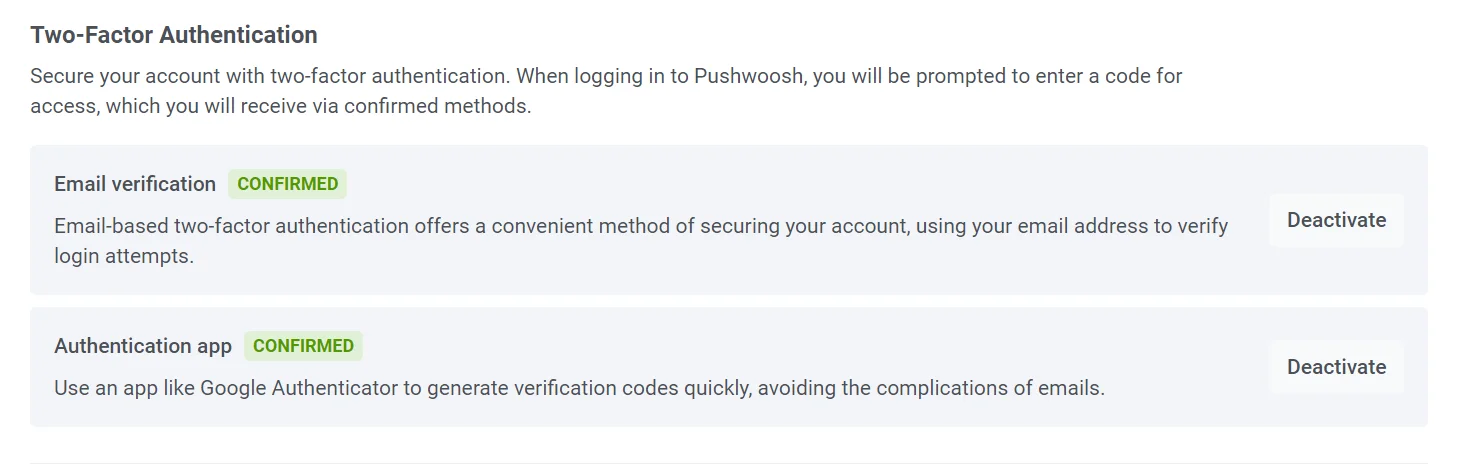
To set up two-factor authentication, select the authentication method in the Two-Factor Authentication section.
Email verification
Anchor link toTo turn on email verification:
-
Click Set up. Pushwoosh sends a verification code to your email.
-
Enter the code in the provided field to activate two-factor authentication.
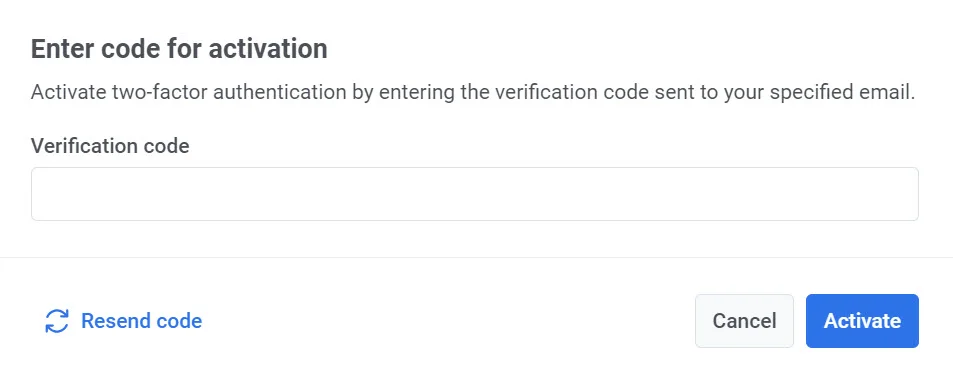
Once email verification is on, a green Confirmed badge appears next to it. To log in to Pushwoosh, you will need to enter a verification code that will be sent to your registered email.
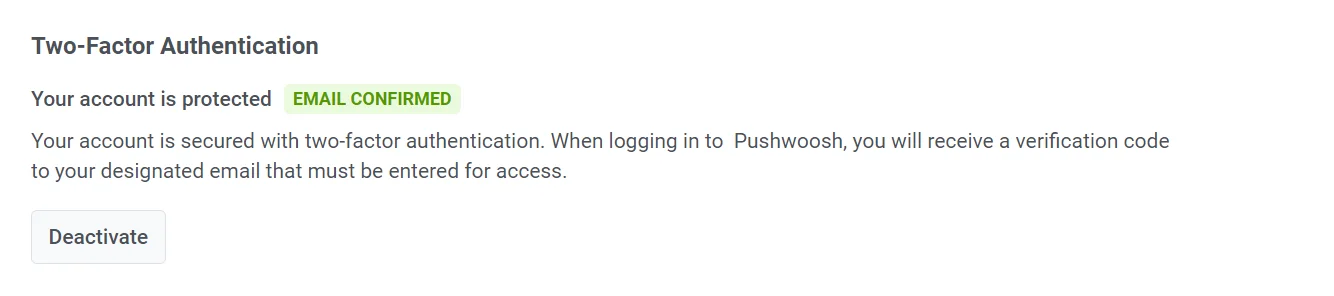
To turn off two-factor authentication:
- Click Deactivate.
- In the pop-up window that appears, enter the verification code sent to your email.
Authentication app
Anchor link toTo quickly and securely generate verification codes, use an app like Google Authenticator. To set it up:
-
Click Set up next to the Authentication app.
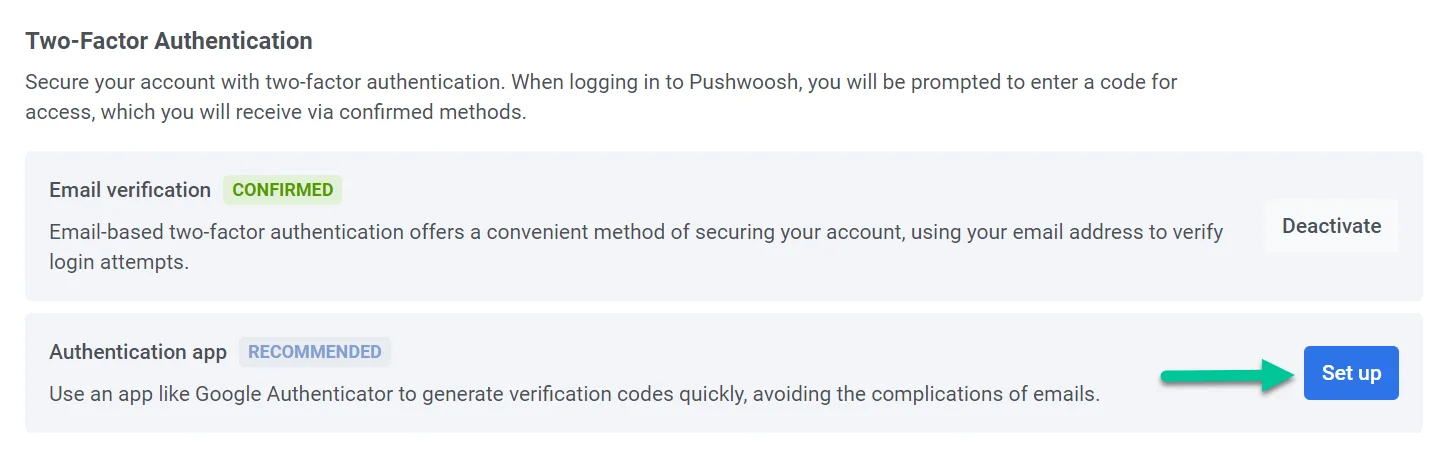
-
Open your authentication app and scan the QR code that appears.
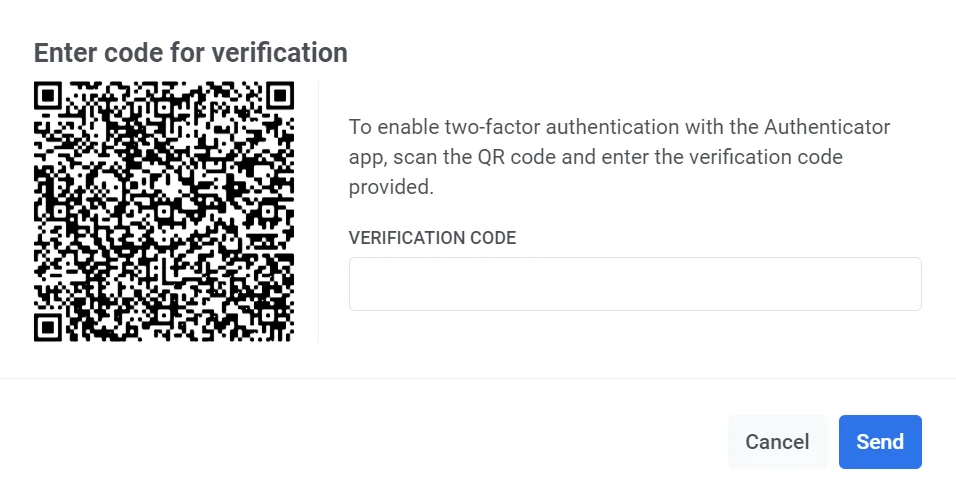
-
Enter the verification code provided by the app.
Once the setup process is complete, you will see the Confirmed status next to the Authentication app option.
Default timezone
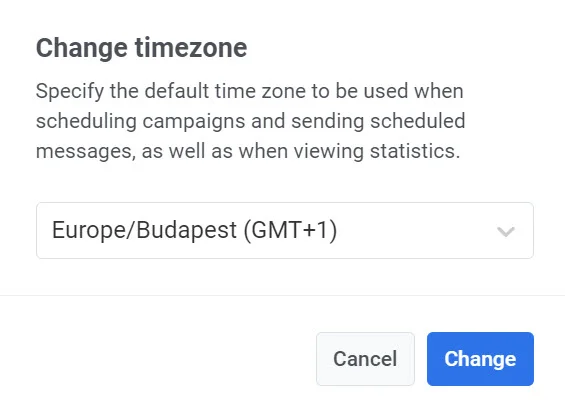
Anchor link toA new account takes the time zone your browser reports at sign-up, whether you sign up with the regular form, an invite, or Google. If the browser doesn’t report one, the account uses Coordinated Universal Time (UTC). Your selected time zone is used for scheduling campaigns, sending scheduled messages, and viewing statistics.
To change your preferred time zone:
-
Click CHANGE.
-
In the pop-up window, select the default time zone.
-
Click the Change button to confirm.
Interface language
Anchor link toTo switch the interface language:
- Open My account: click My account at the bottom of the sidebar, the profile icon at the bottom of the icon bar in the Modern layout, or the profile icon in the top bar.
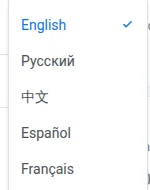
- Open Language and pick one of 14 languages.
All of these menus show the same list. The change applies immediately and reloads the page.
The Account settings page no longer has a separate language control.
Interface theme
Anchor link toTo change the theme:
- Open My account: click My account at the bottom of the sidebar, the profile icon at the bottom of the icon bar in the Modern layout, or the profile icon in the top bar.
- Open Theme and select Light, Dark, or System. System follows your operating system’s theme setting.
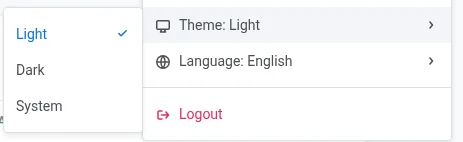
You can also change it here, on the Account settings page. Select Light, Dark, or Auto from the drop-down below. Auto is the same setting as System in the My account menu.
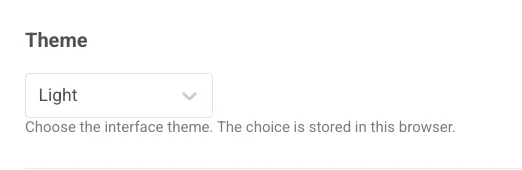
This setting is stored per browser, so it does not carry over if you log in from a different browser or device.
Navigation layout
Anchor link toSwitch the project sidebar between two layouts, Classic and Modern. Classic is the default.
- Open a project.
- Click My account at the bottom of the sidebar.
- Open Navigation: Classic and select Modern.
The sidebar changes right away, without a page reload. The option is in the sidebar’s My account menu, both inside a project and on account pages such as Account settings. The profile menu on the Projects page doesn’t have it.
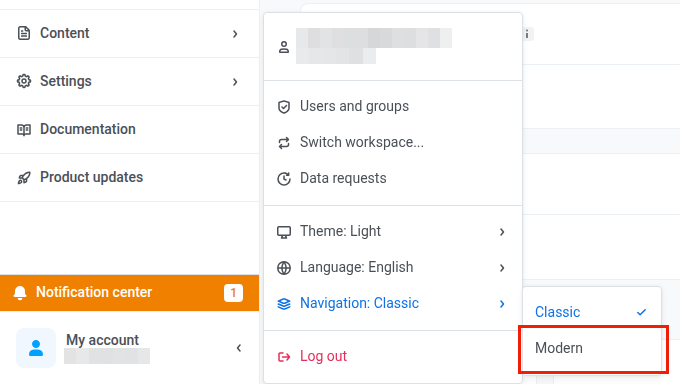
The pages are the same as in Classic. To move around in the Modern layout, which has a narrow icon bar with a panel next to it:
- To open a page, hover an icon in the icon bar and select the page from the list. The panel next to the bar lists the pages of the current section.
- To open My account, Documentation, notifications, Product updates (when there are updates to show), or Projects, use the icons at the bottom of the icon bar.
- To go back to Projects, click Go to project list at the bottom of the panel.
To switch back to Classic:
- Click the profile icon at the bottom of the icon bar to open My account.
- Open Navigation: Modern and select Classic.
The choice is stored per browser, like the theme.
Notification settings
Anchor link toTurn on the toggle to subscribe to our newsletter and receive updates about Pushwoosh.

Workspace
Anchor link toThis section provides an overview of your current workspace activity. Only the account owner and users whose role has the Manage Subscription permission can view and manage it.
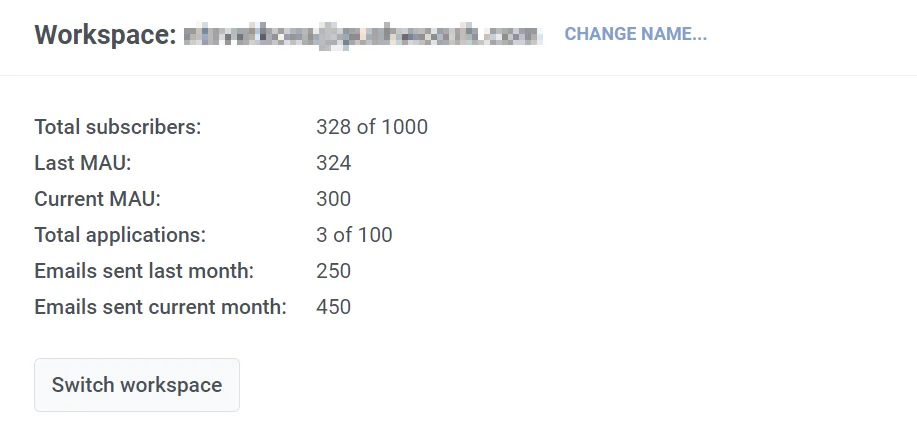
The name of your current workspace is displayed at the top of the section. To change it:
- Click the CHANGE NAME link.
- In the pop-up window, enter a new name.
- Click Change to confirm.
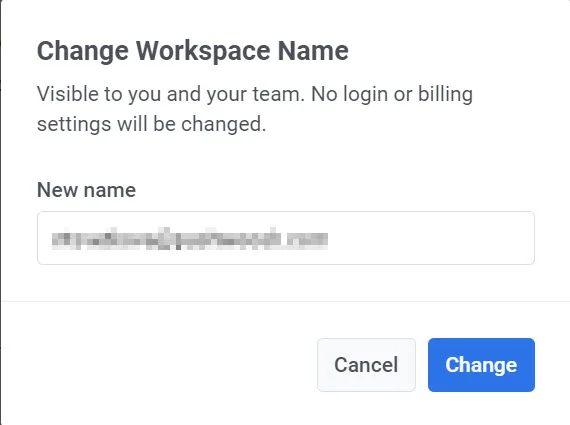
Note that this won’t affect any login or billing settings and will only be visible to you and your team.
Usage metrics
Anchor link toIn this section, you will also find a detailed summary of your Pushwoosh usage statistics, which include:
| Total subscribers | The number of subscribers out of a maximum allowed. |
|---|---|
| Last MAU | The number of Monthly Active Users (MAU) from the previous month |
| Current MAU | The number of Monthly Active Users for the current month |
| Total applications | The number of applications registered with the workspace out of a total allowed number. |
| Emails sent last month | The number of total emails sent from the workspace in the last month |
| Emails sent current month | The number of emails sent in the current month |
Switching between workspaces
Anchor link toIf you manage multiple workspaces, you can easily switch between them using the Switch workspace button.