Create in-app messages in the built-in editor
Build an in-app message template in the Pushwoosh built-in editor without writing code. You get a reusable layout with content blocks, images, buttons, and personalized text that you can show in a Customer Journey, as a one-time in-app, or from a push.
Create a new in-app template
Anchor link toAn in-app template is a reusable design you create once and then show to users in campaigns. You can create one in the built-in editor, upload a custom HTML ZIP, or build a native rich media template. This article covers creating a template from scratch in the built-in editor. Follow the same steps to customize an existing template.
- Go to Content → In-apps.
- Click Create in-app. The built-in editor opens directly.
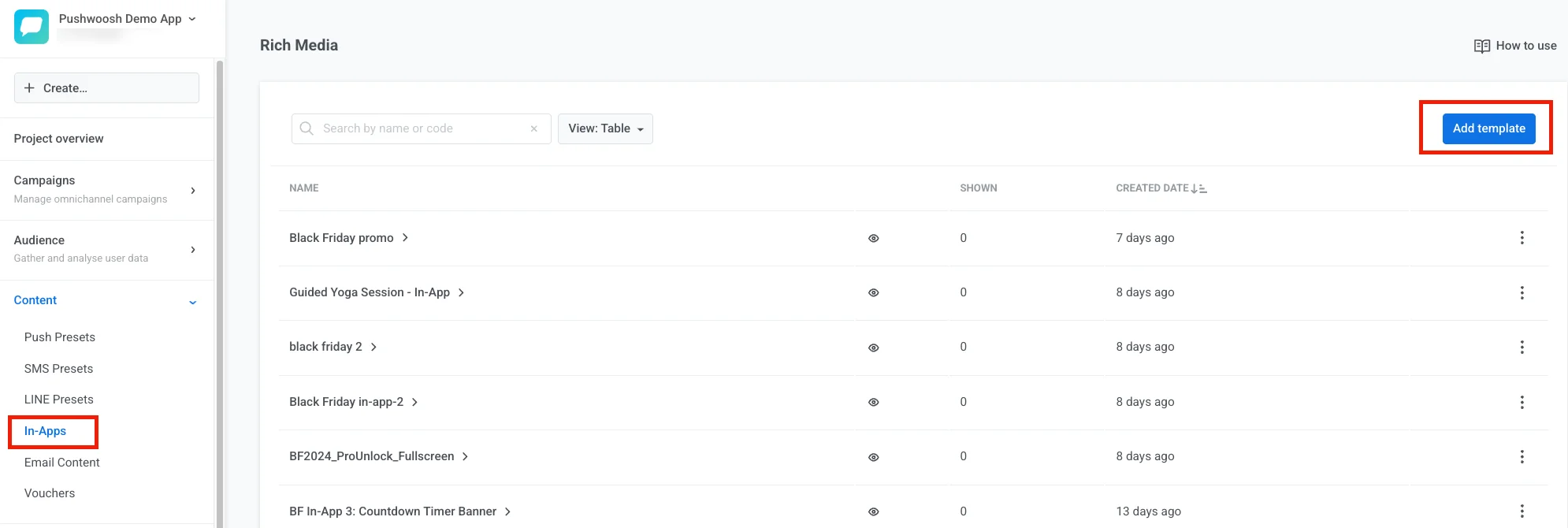
Click the arrow next to Create in-app to build a template a different way:
- Upload ZIP: upload a ZIP file with your HTML in-app message.
- Native in-app: build an SDK-rendered message using ready-made layouts. Learn more
Explore the editor layout
Anchor link toThe built-in editor has four areas. Each one has a clear job.
Top bar
Anchor link toThe top bar is where you manage the template as a whole: its name, undo history, save status, how it looks on device (In-app settings), languages (Auto-translate and the language switcher), phone or desktop preview width (phone offers 360, 390, 393, or 430 px, matching common device widths), and a light/dark canvas toggle (sun/moon icon). See Configure how the in-app looks on device and Localize the template.

Open the ⋮ menu in the top bar for more actions:
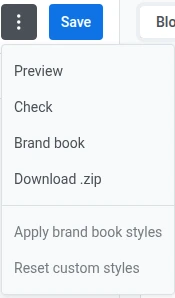
Preview
Anchor link toPreview lets you try the message before you save it: tap buttons, move through multi-screen flows, and check layout on phone or desktop.
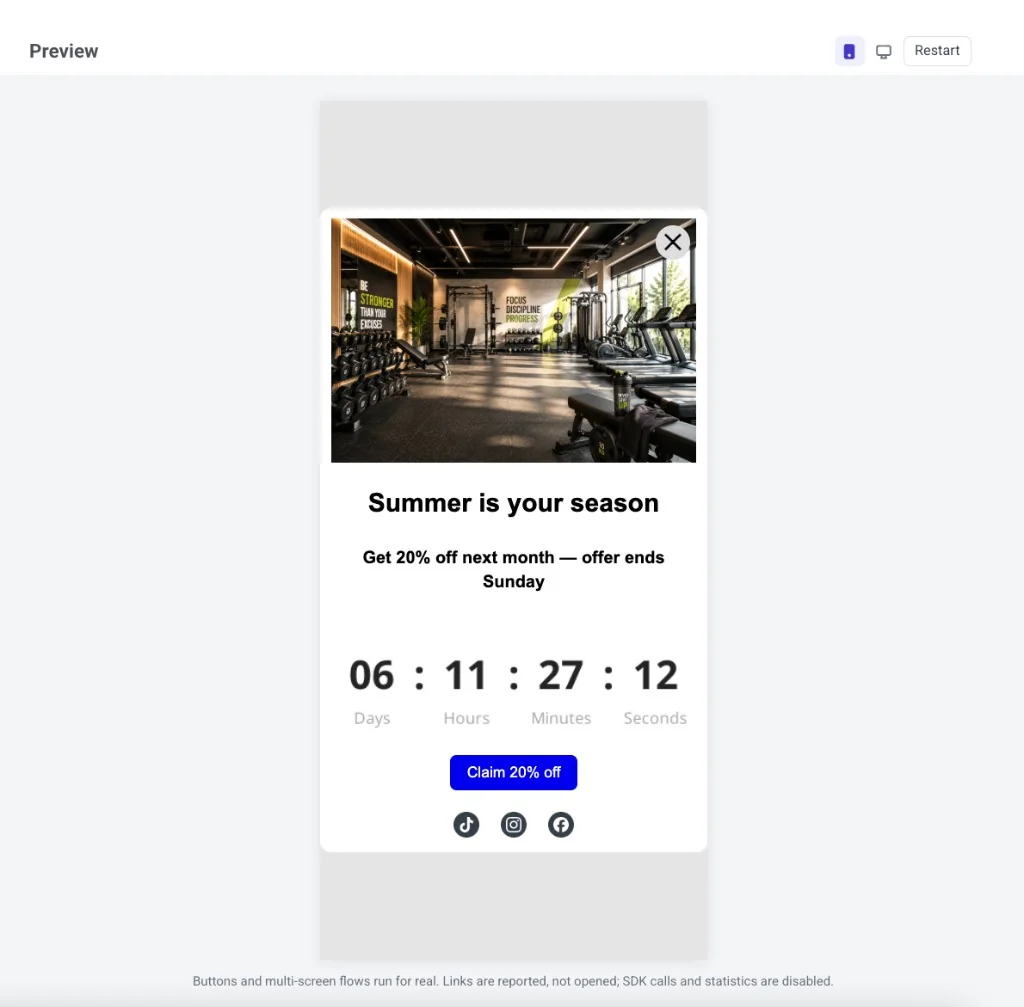
What works in preview:
- Buttons and multi-screen flows run for real.
- Links and deep links are reported, not opened.
- SDK calls and open/click statistics stay off.
- The language matches the language switcher. Merge Tags stay as placeholders.
In the preview header, switch between phone and desktop, and between light and dark, to see all the resulting layouts. Click Restart to show the message from the beginning again. To leave preview, press Esc or click outside the panel.
Check
Anchor link toCheck opens Smart check and scans the template for common issues.
Smart check looks for:
- Buttons, menu items, and image links without a URL, or with a URL that isn’t an http(s),
mailto:,tel:, or deep link (for examplemyapp://promo) address - Unfinished AI placeholder blocks
- Empty image or video slots and missing alt text
- Product cards with a missing or invalid link
- Text contrast that doesn’t meet WCAG AA
- Untranslated content
- A countdown timer whose end date has already passed
- A display condition with a broken or empty rule, a branch that lost the block it chains to, or a condition that won’t apply because dynamic content is disabled for the account
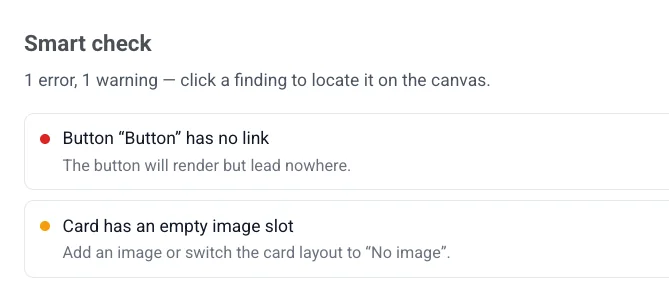
Click a finding to jump straight to the affected element on the canvas. If nothing is wrong, the panel shows All checks passed — the content looks ready to save.
Brand book
Anchor link to- Brand book: open this application’s Brand book.
- Apply brand book styles: restyle the template to match your Brand book (once you’ve set one up).
- Reset custom styles: remove style overrides on the template and return to the defaults.
Download .zip
Anchor link toDownload .zip saves the template as a ZIP file. It downloads the last saved version, so save your changes first. The menu item appears only after the template has been saved at least once — new, unsaved templates don’t show it.
Canvas
Anchor link toEdit the message on the canvas: click text, images, and buttons to change them. Use the phone/desktop toggle in the top bar to check how the layout looks at each width. The toggle only changes the preview, not the layout itself.
Use the sun/moon icon in the top bar to keep editing the canvas while it renders in light or dark. It works even without a Dark mode variant set up — dark colors are derived automatically until you set your own. This is a live editing view, not the read-only Preview panel.
Layers
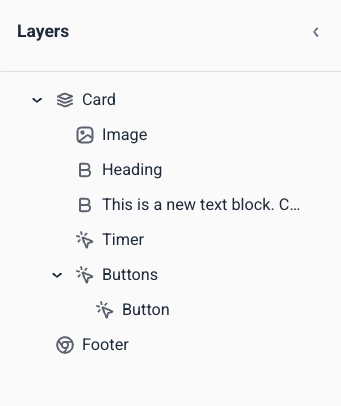
Anchor link toThe Layers panel lists every block in your template as a tree, in the same order as on the canvas. Open it from the left edge to select a nested block (for example, a button inside a group) or drag rows to reorder content.
Right panel
Anchor link toSwitch between three tabs:
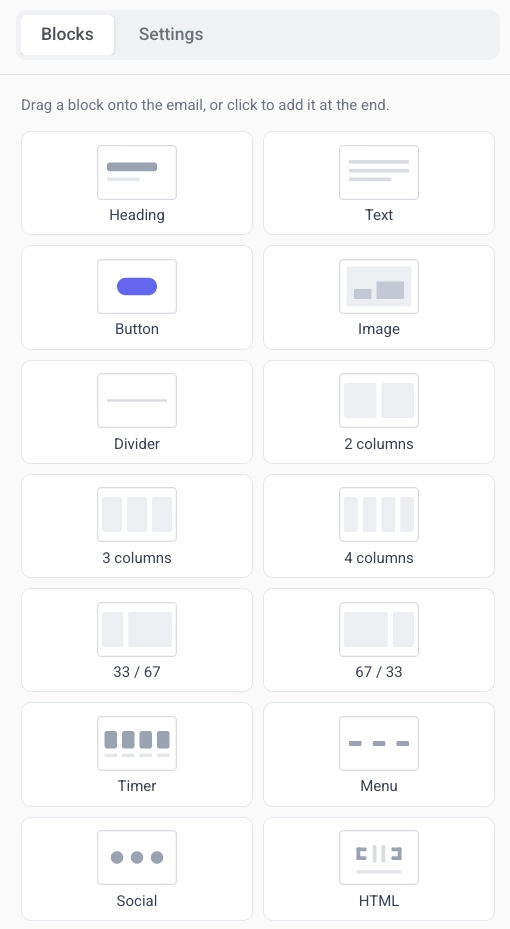
- Blocks: add content to the message. See In-app editor blocks reference.
- Settings: apply styling to the whole template at once. See Configure in-app template settings.
- AI: chat with the AI assistant to generate or edit content from a prompt.
Add content blocks
Anchor link to- Open the Blocks tab in the right panel.
- Drag a block onto the canvas, or click a block to add it at the end of the template.
- Keep adding blocks until the layout is ready.
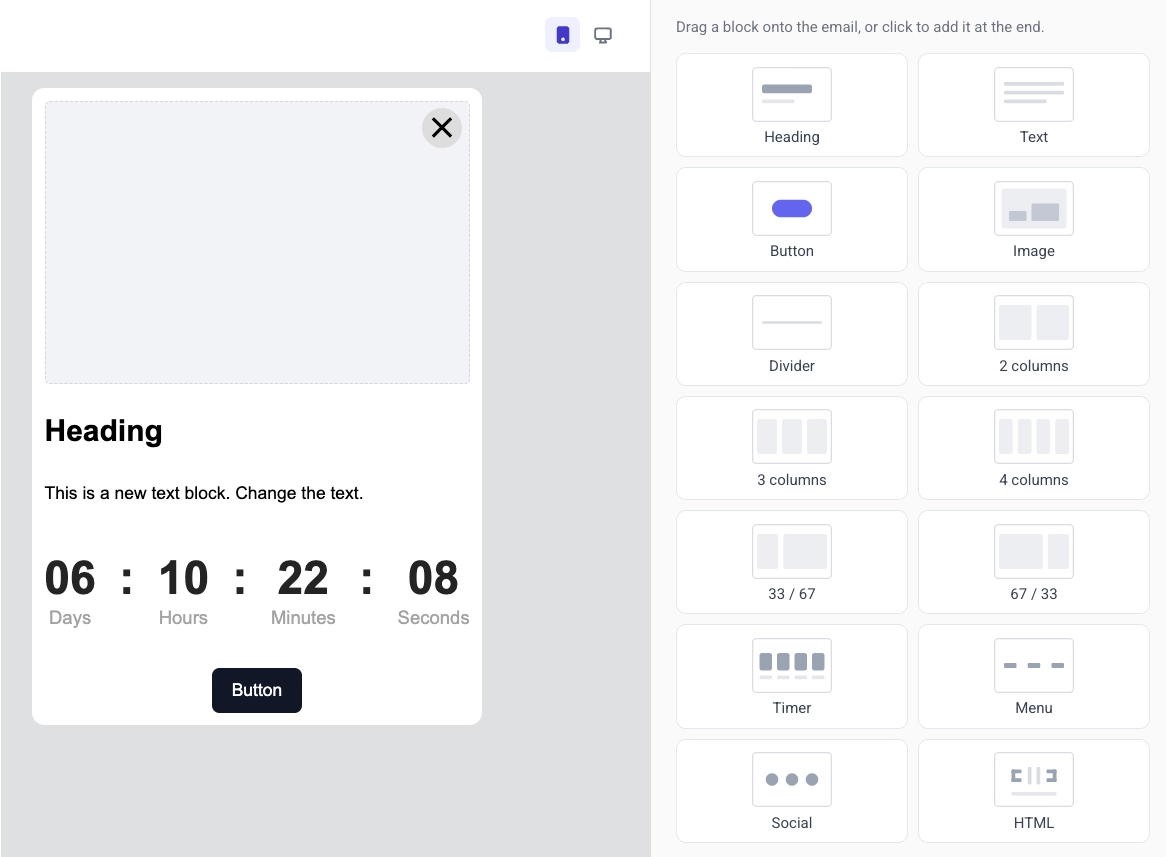
Each block type serves a different purpose in the message:
- Heading: titles and short headlines
- Text: body copy and longer descriptions
- Button: a tappable call to action
- Image: pictures from Media storage, upload, or URL
- Video: a tappable video thumbnail that opens a YouTube or Vimeo video
- Card: an image with heading, text, and button in one layout
- Divider: a line that separates sections
- Columns: side-by-side layouts (2, 3, or 4 equal columns, or 33/67 and 67/33 splits)
- Timer: a countdown for offers and deadlines
- Menu: a row or column of navigation or contact links
- Social: icons that link to your social profiles
- HTML: custom HTML, such as a form, survey, or embedded video
- Products: a grid of product cards from your Product Catalog or a user’s abandoned cart
See the In-app editor blocks reference for settings for each block, and how to save and reuse blocks.
Show blocks to specific users
Anchor link toNot every user needs to see the same blocks. Set a display condition on a block so it shows or hides based on the user’s Tags. You still send one template, but each person only sees the parts that apply to them.
Select the block on the canvas, open Display condition in the right panel, and turn on Show this block conditionally. Learn more
Localize the template
Anchor link toA multi-language template stores localized copy for each language in one in-app design. For how multi-language messaging works across channels, see Multi-language messaging.
To set up multi-language content:
- Click the language switcher in the top bar to open the language list.
- Select the languages you want to add, then click Apply.
- Use the language switcher to move between languages and edit each block’s content for the selected language.
- Click Auto-translate to fill in missing translations automatically — review AI-generated text before saving.
Configure template settings
Anchor link toUse two places to style and place the message:
- Settings tab (right panel): document size, colors, typography, and default styles for blocks.
- In-app settings (top bar): position on screen, animations, and the close button.
Save the template
Anchor link toClick Save in the top bar to save your changes. Use Undo/Redo in the top bar to step back and forward through your edits.
Update translations from your own systems
Anchor link toYour development team can update a saved template’s translations through the Pushwoosh API or an AI client connected to the ManyMoney AI MCP server, without resending the template’s HTML or design.
This only works on a template that has already been saved once (see Save the template above). A template with no saved content has nothing to merge translations into.
The update merges only the languages and text keys sent in the localization field. Every other language, key, and the visual design stay as saved.
- Sending a key with no value removes that key from its language.
- Sending a language with no value removes the whole language from the template.
- The default language can switch to any language left in the template after the update.
- The update is rejected if it would remove every language from the template, or if the requested default language isn’t one of the languages left after the merge.
For this, you’ll need assistance from your development team.