New and active players
These recipes cover the New and Playing stages: players who are learning the game and players who play every day. Before you build them, read the best practices for every journey.
Onboarding for new players
Anchor link to- Use it when: new players install the game but do not finish the tutorial.
- Starts when: a player starts the tutorial (
Tutorial started). - What it does: sends an in-app nudge 15 minutes after the tutorial starts, then a push after 24 hours, until the player finishes the tutorial. The first nudge is an in-app message that comes early, while the player may still be in the game, because most players have not allowed notifications yet.
- Content to prepare: an in-app template and a push preset, both pointing the player back to the tutorial.
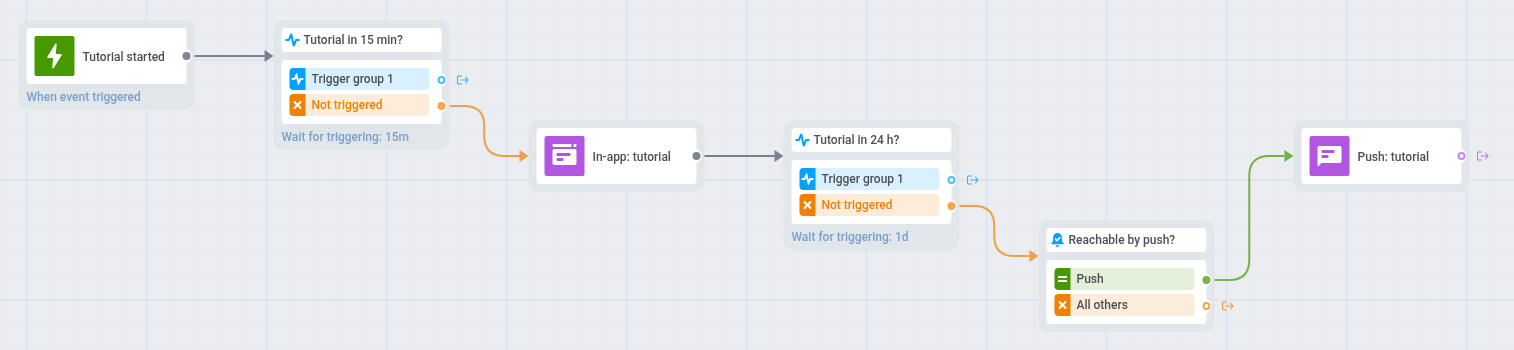
- On the journey canvas, add a Trigger-based entry on
Tutorial started. Do not usePW_DeviceRegisteredhere: it fires when the game asks for push permission, which this playbook moves to after the tutorial. - Add a Wait for Trigger step on
Tutorial completedwith the conditioncompletionis true, and set the waiting period to 15 minutes. - Leave the Trigger group 1 branch empty, because players who finish the tutorial need no further messages.
- On the Not triggered branch, add an In-app element with a message that points back to the tutorial, for example: “Your first reward is one step away. Finish the tutorial to claim it.” The player sees it the next time they open or return to the game.
- Add a second Wait for Trigger step on
Tutorial completedwith the conditioncompletionis true, and set the waiting period to 24 hours. Leave its Trigger group 1 branch empty too. - On the Not triggered branch, add a Reachability check.
- For players reachable by push, add a push that sends them back to the tutorial, for example: “Your adventure is waiting. Finish the tutorial to unlock your first reward.”
- Open Settings on the canvas, select Conversion goals, choose
Tutorial completedwithcompletionis true, and select End journey after this event. - Open Settings, select Campaign Entry Limit, and choose once in a lifetime, so a player who restarts the tutorial does not get the nudges again.
The push in step 7 reaches only players whose devices already allow notifications. The others leave the journey, because a second in-app would repeat the first one.
This journey starts only for players who start the tutorial after you launch it. To reach players who started earlier, build a journey with a one-time Audience-based entry on the Tutorial drop-off segment. It takes in only players whose devices already have a push token, which the game gets when it asks for push permission.
For a longer walkthrough of onboarding journeys, see Onboard users with Pushwoosh.
Second session for new players
Anchor link to- Use it when: new players finish the tutorial but do not come back the next day.
- Starts when: a player finishes the tutorial (
Tutorial completed). - What it does: waits about a day after the tutorial and, if the player has not opened the game again, sends a push that gives a reason to come back.
- Content to prepare: a push preset with a reason to return, such as a reward waiting in the game.
- Needs: players who allowed notifications during their first session. If the game asks for permission only at the next launch, this journey reaches few new players.
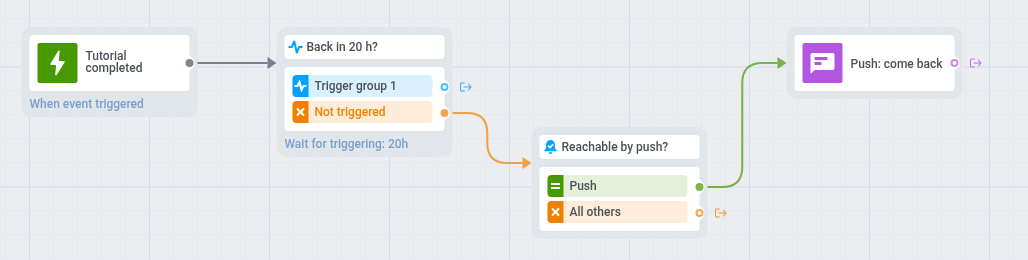
- On the journey canvas, add a Trigger-based entry on
Tutorial completedwith the conditioncompletionis true. - Add a Wait for Trigger step on
PW_ApplicationOpenand set the waiting period to 20 hours. Leave its Trigger group 1 branch empty, because players who came back need no message. - On the Not triggered branch, add a Reachability check.
- For players reachable by push, add a push, for example: “Your daily chest is ready. Come back and open it.”
- Open Settings, select Conversion goals, choose
PW_ApplicationOpen, and select End journey after this event. - Open Settings, select Campaign Entry Limit, and choose once in a lifetime.
Help for stuck players
Anchor link to- Use it when: players keep failing levels and may quit the game.
- Starts when: a player enters the Stuck players segment. Pushwoosh checks the segment on a schedule you set, for example daily.
- What it does: shows an in-app hint or gift, then sends a push that offers help if the player does not complete the level within 2 days. The hint reaches the player before they quit, and the push is a second touch for players who have left the game.
- Content to prepare: an in-app template with a hint or a gift, and a push preset that offers help.
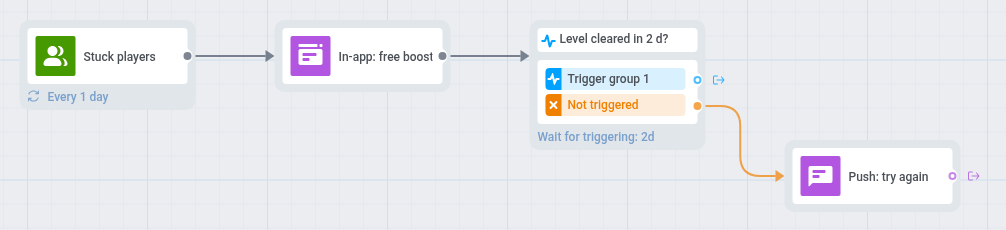
- On the journey canvas, add an Audience-based entry with the Stuck players segment.
- Set the entry schedule to Recurring entry and choose Periodically, for example daily.
- Add an In-app element with a hint or a gift for the level, for example: “Stuck on this one? Here is a free boost to get you through.” The player sees it the next time they open or return to the game.
- Add a Wait for Trigger on
Level completedfor 2 days. - On the Not triggered branch, add a push that offers help and sets a deep link to the level, for example: “Need a hand? Your boost is ready. Tap to try the level again.”
- Open Settings, select Campaign Entry Limit, and choose once a week.
- Open Settings, select Conversion goals, choose
Level completed, and select End journey after this event.
Players without push get only the in-app message, because a second in-app would repeat the same boost.
Daily reward reminder
Anchor link to- Use it when: your game has a daily reward and you want players to collect it every day.
- Starts when: a player claims the reward (
Daily reward claimed). - What it does: waits for your reward cooldown after each claim, then reminds the player to collect the reward, unless the player has already claimed it. The reminder counts from the latest claim.
- Content to prepare: a push preset and an in-app template with the same reminder.
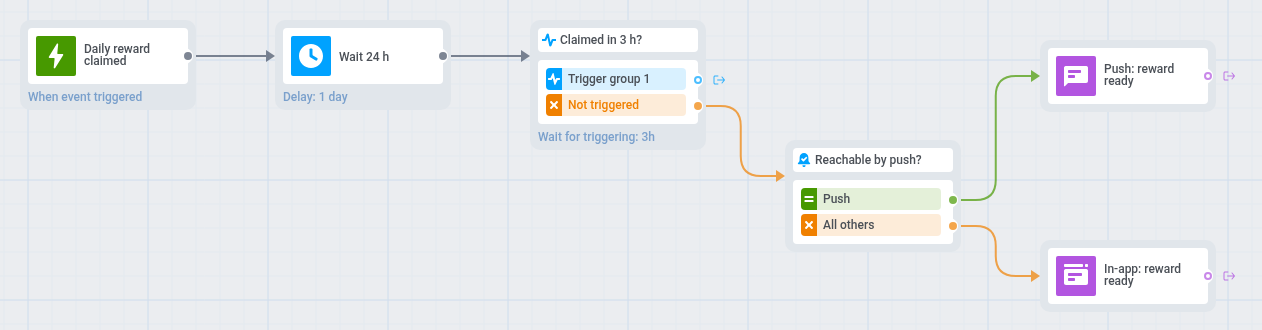
- On the journey canvas, add a Trigger-based entry on
Daily reward claimedand set the entry to Allow re-entry. Each claim restarts the journey, so the reminder always counts from the latest claim. - Add a Time Delay with a fixed duration equal to your reward cooldown, for example 24 hours.
- Add a Wait for Trigger step on
Daily reward claimedand set the waiting period to a few hours. The reward can’t be claimed before the cooldown ends, so the step catches every claim after the delay, and players who claim skip the reminder. - On the Not triggered branch, add a Reachability check.
- For players reachable by push, add a push that tells the player the reward is ready, for example: “Your daily reward is waiting for you.” Set a deep link so the push opens the reward screen.
- For the others, add an In-app element with the same reminder and set In-app expiration to 1 day. The player sees it the next time they open or return to the game.
- Set a Silence period for push with the option to send the message after the period ends.
- Open Settings, select Conversion goals, and choose
Daily reward claimed.