# Message delivery settings
## Configure Global frequency capping
To prevent overwhelming your users with multiple messages from overlapping campaigns, use **Global frequency capping**. This feature limits the number of marketing messages a user receives within a specific timeframe. Once the message limit is reached for a channel, no further messages will be sent until the period resets.
To control the number of messages sent to a user within a specific timeframe:
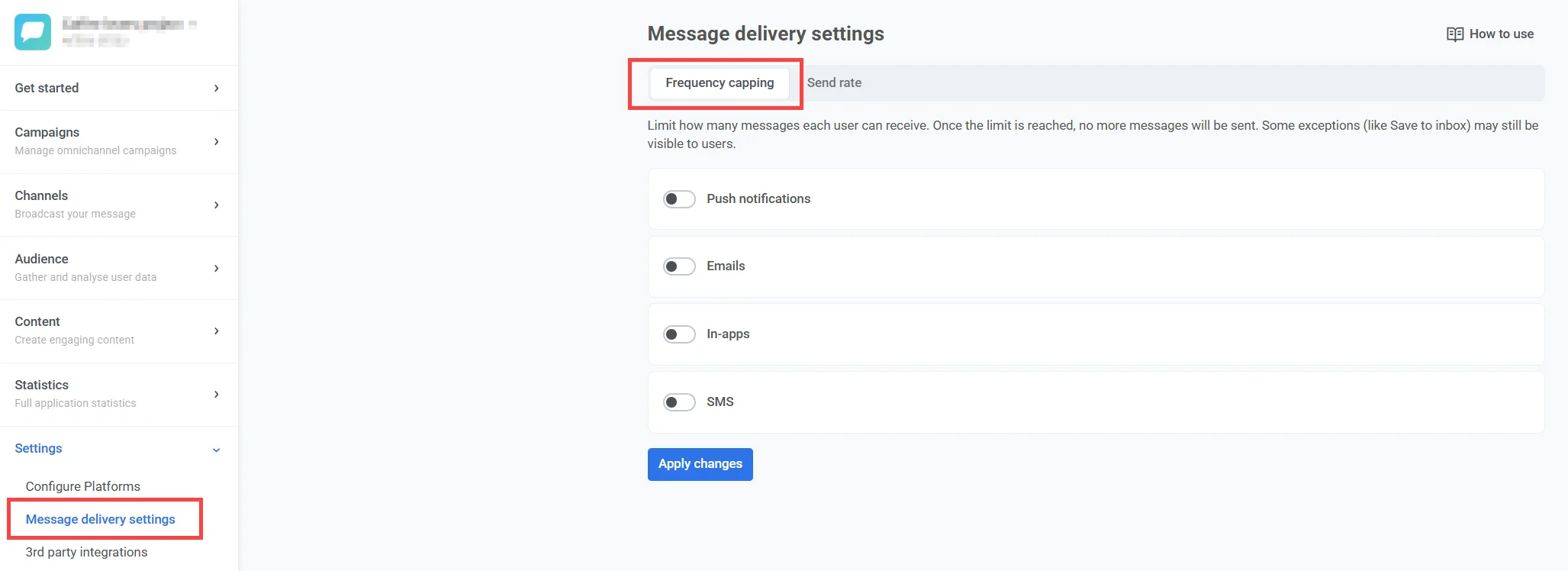
1. Go to **Settings > Message delivery settings > Frequency capping**.
2. Toggle the switch on to enable frequency capping for the desired channels ([push notifications](/product/messaging-channels/push-notifications/), [emails](/product/messaging-channels/emails/), [in-apps](/product/messaging-channels/in-apps/), [SMS](/product/messaging-channels/sms/), [WhatsApp](/product/messaging-channels/whatsapp-messages/)).
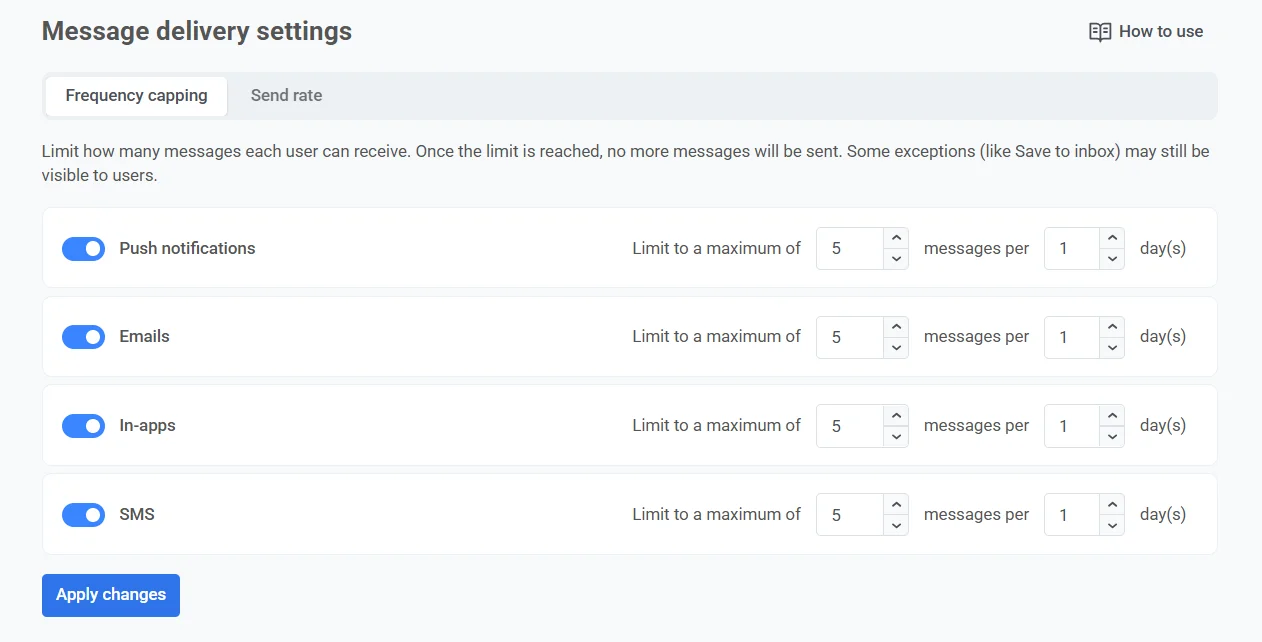
3. Set the maximum number of messages per user for each channel and the corresponding time period.
> For example, you can allow up to 4 push notifications, 2 emails, and 2 WhatsApp messages in a 5-day period.
The maximum frequency capping period is 30 days.
### Exclude users from global frequency capping
You can exclude specific users from global frequency capping limits. Messages to excluded users bypass channel limits regardless of the configured period.
To exclude users from capping:
1. Go to **Settings > Message delivery settings > Frequency capping**.
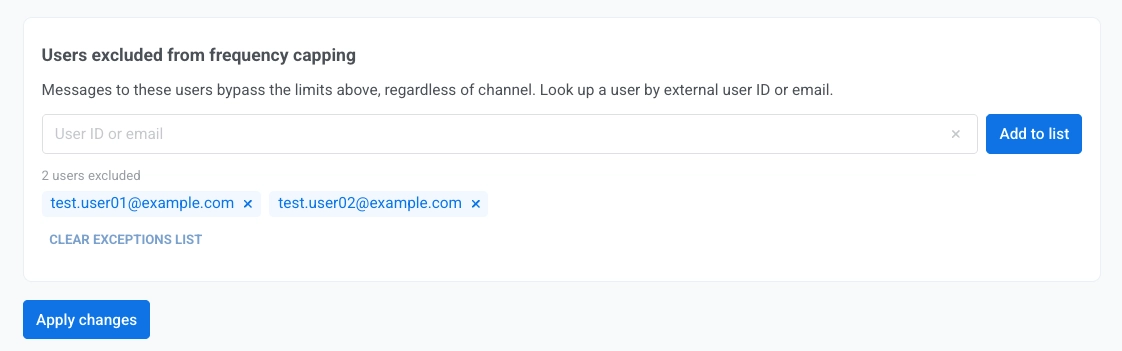
2. In **Users excluded from frequency capping**, enter one [User ID](/product/pushwoosh-knowledge-hub/users-userids/) or one email at a time.
3. Click **Add to list**.
4. Repeat steps 2-3 for each additional user.
5. Click **Apply changes**.
Users remain excluded until you remove them from the list in message delivery settings.
To clear the exclusions list, click **Clear exceptions list**.
### Global frequency capping for Journey messages
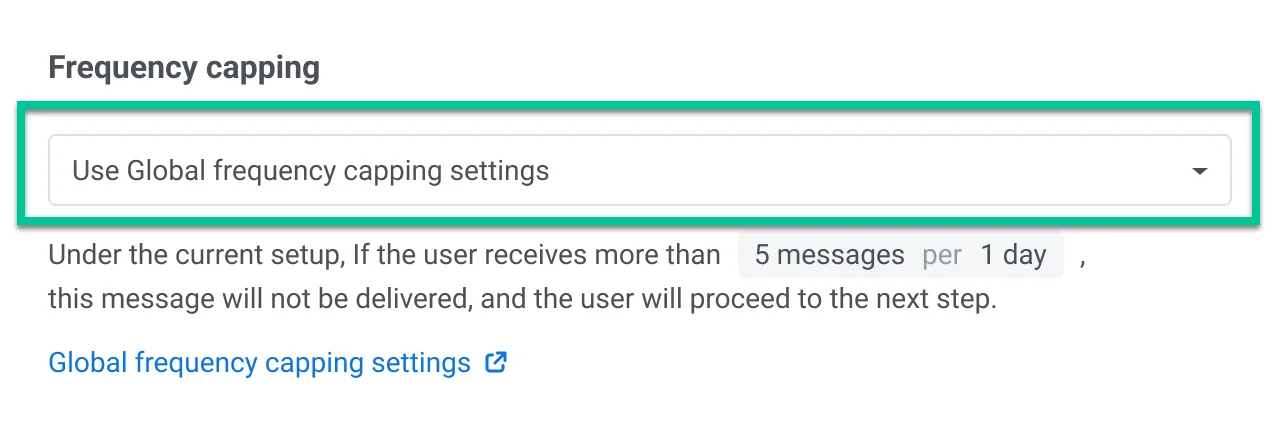
When creating message elements in customer journeys, **Global frequency capping** settings are applied by default.
However, you have the option to customize how certain messages are handled by overriding the Global frequency capping settings. You can do the following:
#### Ignore Global frequency capping
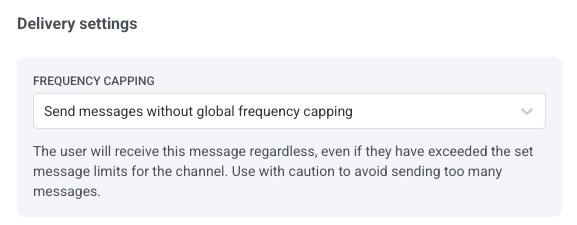
Select **Send messages without global frequency capping** to bypass global frequency capping rules. The user will receive this message regardless, even if they have exceeded the set message limits for the channel. Use with caution to avoid sending too many messages.
#### Use custom frequency capping
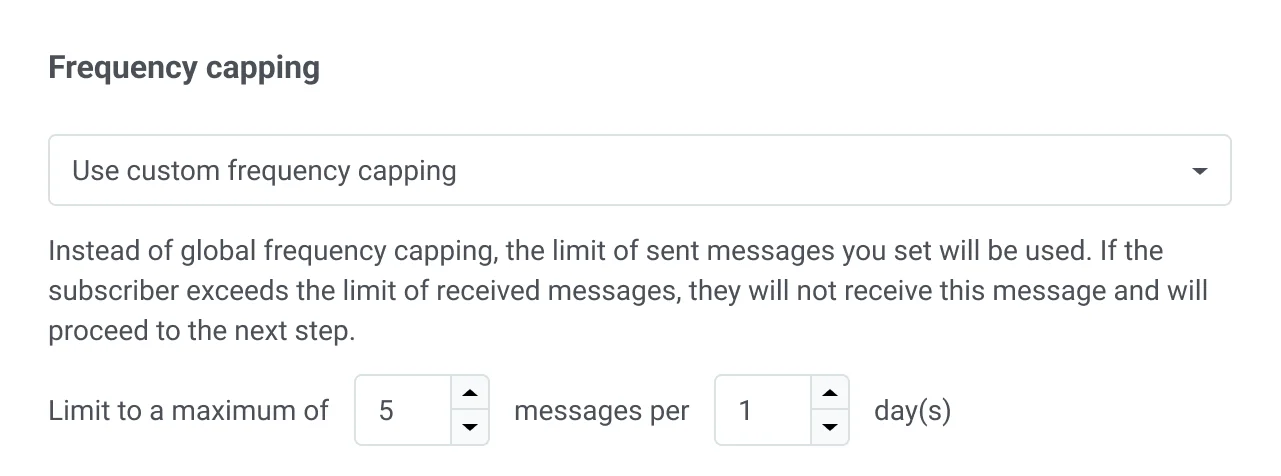
This option allows you to set a custom limit on the number of messages sent within a specified period. Here, define the number of messages (e.g., 5) and the time frame (e.g., 10 days) in which these messages can be sent.
### Example scenario
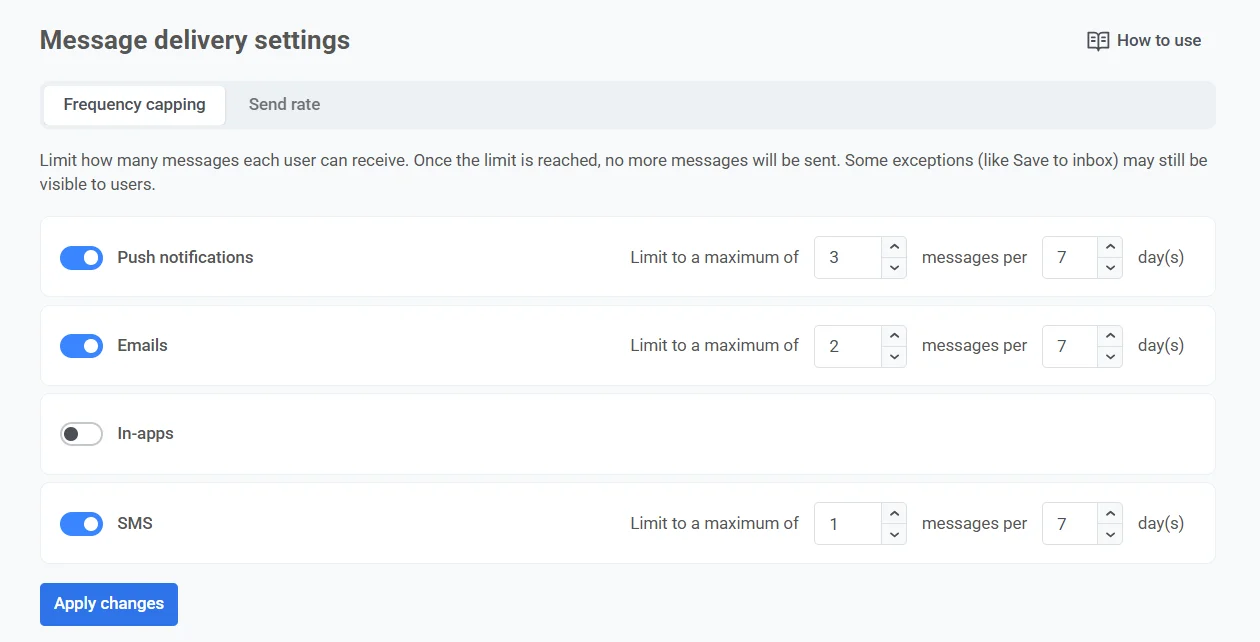
Imagine you're managing multiple marketing campaigns across push notifications, emails, and SMS. To prevent overwhelming your customers with too many messages, you decide to set up Frequency capping and limit the number of messages each user can receive to 3 push notifications, 2 emails, and 1 SMS per user within 7 days.
Here are the steps to set it up:
##### Enable Global frequency capping
1. Go to **Settings > Message delivery settings > Frequency capping**.
2. Toggle the switch on for push notifications, emails, and SMS.
3. Specify the maximum number of messages a user can receive: 3 push notifications, 2 emails, and 1 SMS.
4. Specify the time period for 7 days.
##### Configure critical messages
If you want to make sure that important messages, such as payment confirmations, are always delivered immediately, regardless of any message limits, select **Send messages without global frequency capping** in the delivery settings of the specific journey steps where this is needed.
Examples of other critical messages can include security alerts, password reset requests, critical app updates, and more.
##### Customize capping for specific messages
Let’s say you want to send a special offer push notification every time a user completes a specific in-app action. However, to avoid repeating the same message too often, you want to ensure this message is shown no more than once every 3 days, even though your Frequency capping allows 3 push notifications per week.
Here’s how to configure that:
1. Set up a customer journey triggered by the user completing the target action.
2. Within the customer journey builder, go to the settings for the message element and select **Use custom frequency capping**.
3. Set the custom cap to 1 message every 3 days.
### Global frequency capping FAQ
##### How does Global frequency capping calculate time?
A "day" in frequency capping is exactly 24 hours from the time a message is sent. For example, if a message is sent on **January 12, 2024, at 01:00 AM**, the capping period applies until **January 13, 2024, at 01:00 AM**.
##### Which messages are affected by Global frequency capping?
Global capping limits **marketing** messages. **Transactional** messages are not subject to frequency capping. The rule applies across channels and sources, including:
* API-based messages
* Customer Journey messages
* One-time push notifications and emails
* In-app campaigns
* SMS and WhatsApp messages
##### Can I exclude specific users from Global frequency capping?
Yes. In **Settings > Message delivery settings > Frequency capping**, add a `User ID` or email to **Users excluded from frequency capping**. These users bypass global capping limits.
##### What happens if I change Global frequency capping settings while a Customer Journey is running?
The updated settings apply immediately. Pushwoosh checks the capping rules every time it attempts to send a message.
##### What happens if I disable Global frequency capping?
Future messages will no longer be limited by capping rules. However, messages that were previously blocked due to capping will not be sent retroactively.
##### How does enabling Global frequency capping affect ongoing campaigns?
All active campaigns, whether launched via API or through the Pushwoosh interface, will immediately follow the new capping rules.
##### What if I enable Global frequency capping but still use the old capping settings in the Send Push form (legacy)?
The system will continue using the old capping settings for messages sent via the legacy Send Push form.
##### How does Frequency capping affect API-based messaging?
**Marketing** API messages are subject to global capping. Set `message_type` to **transactional** in [`/createMessage`](/developer/api-reference/messages-api/#createmessage) or `email_type` to **transactional** in [`/createEmailMessage`](/developer/api-reference/email-api/#createemailmessage) so those sends are not capped. If you omit the type in the API request, frequency capping applies.
## View frequency capping statistics
You can see how frequency capping affects your messages in several places. Each view reports two metrics: **Suppressions** (messages not sent because the recipient had already reached their frequency capping limit) and **Affected users** (unique users who had at least one message suppressed).
* **Project dashboard**: the [Project overview](/product/first-steps/pushwoosh-interface-overview/#project-overview) shows a Frequency capping block for the last 30 days.
* **Individual message statistics**: the Performance tab of [push notification](/product/statistics-and-analytics/messaging-statistics/push-notification-statistics/) and [email](/product/statistics-and-analytics/messaging-statistics/email-statistics/) message statistics includes a Frequency capping row.
* **Aggregated messages**: the Performance tab of [aggregated message statistics](/product/statistics-and-analytics/aggregated-messages/) includes a Frequency capping row.
* **Customer Journey**: the [Communications statistics](/product/statistics-and-analytics/journey-statistics/overall-journey-statistics/#frequency-capping) window reports frequency capping on the Push, Email, SMS, and WhatsApp tabs.
## Set send rate limits
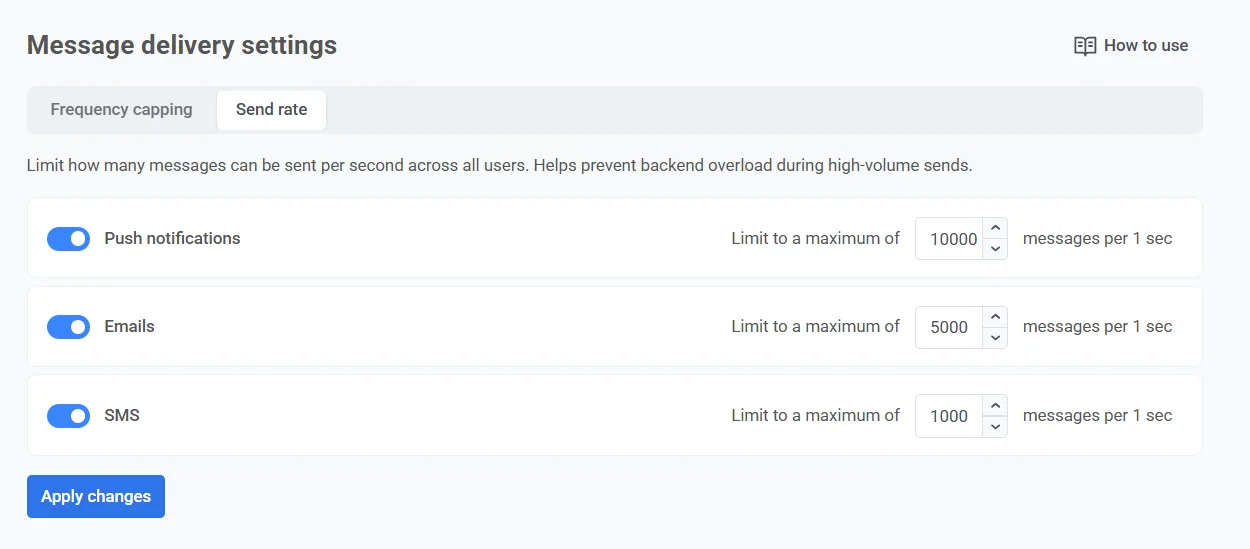
Set individual send rate limits for each messaging channel: push notifications, emails, and SMS.
To set up send rate limits:
1. Go to **Settings > Message delivery settings > Send rate**.
2. Enable or disable rate limiting for each channel as needed.
3. Specify the maximum number of messages to be sent per second to manage delivery speed and prevent backend overload during high-volume sends.
4. Click **Apply changes**, then confirm to save your settings.
### Controlling send rate limits for individual messages
In addition to setting a global send rate for each channel, you can also control the send rate for individual messages in customer journey. This is done in the settings of the specific message or journey element.
You can choose to:
* Use global send rate settings
* Send messages without send rate
* Use custom send rate
For detailed instructions on configuring send rate per message, see the [channel-specific element guides.](/product/customer-journey/journey-elements/channels/)
 2. Toggle the switch on to enable frequency capping for the desired channels ([push notifications](/product/messaging-channels/push-notifications/), [emails](/product/messaging-channels/emails/), [in-apps](/product/messaging-channels/in-apps/), [SMS](/product/messaging-channels/sms/), [WhatsApp](/product/messaging-channels/whatsapp-messages/)).
3. Set the maximum number of messages per user for each channel and the corresponding time period.
2. Toggle the switch on to enable frequency capping for the desired channels ([push notifications](/product/messaging-channels/push-notifications/), [emails](/product/messaging-channels/emails/), [in-apps](/product/messaging-channels/in-apps/), [SMS](/product/messaging-channels/sms/), [WhatsApp](/product/messaging-channels/whatsapp-messages/)).
3. Set the maximum number of messages per user for each channel and the corresponding time period.
 > For example, you can allow up to 4 push notifications, 2 emails, and 2 WhatsApp messages in a 5-day period.
The maximum frequency capping period is 30 days.
### Exclude users from global frequency capping
You can exclude specific users from global frequency capping limits. Messages to excluded users bypass channel limits regardless of the configured period.
To exclude users from capping:
1. Go to **Settings > Message delivery settings > Frequency capping**.
2. In **Users excluded from frequency capping**, enter one [User ID](/product/pushwoosh-knowledge-hub/users-userids/) or one email at a time.
3. Click **Add to list**.
4. Repeat steps 2-3 for each additional user.
5. Click **Apply changes**.
> For example, you can allow up to 4 push notifications, 2 emails, and 2 WhatsApp messages in a 5-day period.
The maximum frequency capping period is 30 days.
### Exclude users from global frequency capping
You can exclude specific users from global frequency capping limits. Messages to excluded users bypass channel limits regardless of the configured period.
To exclude users from capping:
1. Go to **Settings > Message delivery settings > Frequency capping**.
2. In **Users excluded from frequency capping**, enter one [User ID](/product/pushwoosh-knowledge-hub/users-userids/) or one email at a time.
3. Click **Add to list**.
4. Repeat steps 2-3 for each additional user.
5. Click **Apply changes**.
 Users remain excluded until you remove them from the list in message delivery settings.
To clear the exclusions list, click **Clear exceptions list**.
### Global frequency capping for Journey messages
When creating message elements in customer journeys, **Global frequency capping** settings are applied by default.
Users remain excluded until you remove them from the list in message delivery settings.
To clear the exclusions list, click **Clear exceptions list**.
### Global frequency capping for Journey messages
When creating message elements in customer journeys, **Global frequency capping** settings are applied by default.
 However, you have the option to customize how certain messages are handled by overriding the Global frequency capping settings. You can do the following:
#### Ignore Global frequency capping
Select **Send messages without global frequency capping** to bypass global frequency capping rules. The user will receive this message regardless, even if they have exceeded the set message limits for the channel. Use with caution to avoid sending too many messages.
However, you have the option to customize how certain messages are handled by overriding the Global frequency capping settings. You can do the following:
#### Ignore Global frequency capping
Select **Send messages without global frequency capping** to bypass global frequency capping rules. The user will receive this message regardless, even if they have exceeded the set message limits for the channel. Use with caution to avoid sending too many messages.
 #### Use custom frequency capping
This option allows you to set a custom limit on the number of messages sent within a specified period. Here, define the number of messages (e.g., 5) and the time frame (e.g., 10 days) in which these messages can be sent.
#### Use custom frequency capping
This option allows you to set a custom limit on the number of messages sent within a specified period. Here, define the number of messages (e.g., 5) and the time frame (e.g., 10 days) in which these messages can be sent.
 ### Example scenario
Imagine you're managing multiple marketing campaigns across push notifications, emails, and SMS. To prevent overwhelming your customers with too many messages, you decide to set up Frequency capping and limit the number of messages each user can receive to 3 push notifications, 2 emails, and 1 SMS per user within 7 days.
Here are the steps to set it up:
##### Enable Global frequency capping
1. Go to **Settings > Message delivery settings > Frequency capping**.
2. Toggle the switch on for push notifications, emails, and SMS.
3. Specify the maximum number of messages a user can receive: 3 push notifications, 2 emails, and 1 SMS.
4. Specify the time period for 7 days.
### Example scenario
Imagine you're managing multiple marketing campaigns across push notifications, emails, and SMS. To prevent overwhelming your customers with too many messages, you decide to set up Frequency capping and limit the number of messages each user can receive to 3 push notifications, 2 emails, and 1 SMS per user within 7 days.
Here are the steps to set it up:
##### Enable Global frequency capping
1. Go to **Settings > Message delivery settings > Frequency capping**.
2. Toggle the switch on for push notifications, emails, and SMS.
3. Specify the maximum number of messages a user can receive: 3 push notifications, 2 emails, and 1 SMS.
4. Specify the time period for 7 days.
 ##### Configure critical messages
If you want to make sure that important messages, such as payment confirmations, are always delivered immediately, regardless of any message limits, select **Send messages without global frequency capping** in the delivery settings of the specific journey steps where this is needed.
##### Configure critical messages
If you want to make sure that important messages, such as payment confirmations, are always delivered immediately, regardless of any message limits, select **Send messages without global frequency capping** in the delivery settings of the specific journey steps where this is needed.
 4. Click **Apply changes**, then confirm to save your settings.
### Controlling send rate limits for individual messages
In addition to setting a global send rate for each channel, you can also control the send rate for individual messages in customer journey. This is done in the settings of the specific message or journey element.
You can choose to:
* Use global send rate settings
* Send messages without send rate
* Use custom send rate
For detailed instructions on configuring send rate per message, see the [channel-specific element guides.](/product/customer-journey/journey-elements/channels/)
4. Click **Apply changes**, then confirm to save your settings.
### Controlling send rate limits for individual messages
In addition to setting a global send rate for each channel, you can also control the send rate for individual messages in customer journey. This is done in the settings of the specific message or journey element.
You can choose to:
* Use global send rate settings
* Send messages without send rate
* Use custom send rate
For detailed instructions on configuring send rate per message, see the [channel-specific element guides.](/product/customer-journey/journey-elements/channels/)