In-app
To show an in-app message in a journey, add the In-App element next to the step that should trigger it. Then choose a Rich Media page to display.
When the message is displayed
Anchor link to- If the app is open when the In-App element is triggered, the message is shown immediately.
- If the app is closed, the message is shown the next time the user opens the app.
Click the In-App element to open its settings. Configure the following:
Select template and set expiration
Anchor link toIn Media Source, select a Rich Media template (newest first) and click Apply. Set In-app expiration (number of days the message is available).
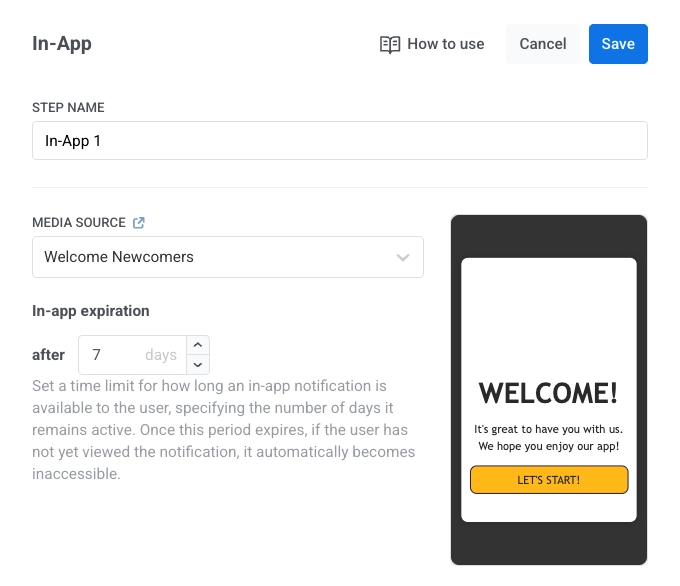
Set message type
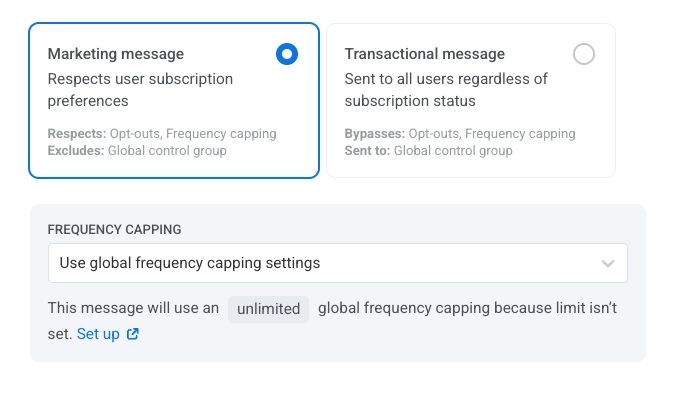
Anchor link toChoose Marketing message or Transactional message:
- Marketing message: For campaigns and promos. All rules and limits apply. Respects: opt-outs, frequency capping, and the silence period. Excludes: the global control group users.
- Transactional message: For operational or service messages. Rules and limits don’t apply. Bypasses: opt-outs, frequency capping, and the silence period. Sent to: the global control group users.
Learn more about the difference between marketing and transactional messages.
Set frequency capping
Anchor link toUse Frequency capping to limit how often users receive in-app messages, preventing over-messaging and reducing churn. In the In-App element settings, choose one of the following options:
-
Use Global frequency capping settings
Apply the project-wide limits configured in your Global frequency capping settings.
For example, if the global limit is set to 3 messages in 9 days, additional messages exceeding this limit will be skipped.
-
Ignore Global frequency capping
The user will receive this message even if they’ve exceeded the channel’s message limits. Use this option with caution to avoid over-messaging.
-
Use custom frequency capping
Set a custom message limit for this message. If the user exceeds this custom cap, the message will be skipped, and the user will proceed to the next step.