# Build segments by events
**Event-based segmentation** allows you to target users based on their actual behavior and actions within your app or website. This creates highly personalized and effective campaigns by focusing on user engagement patterns.
## Build segments by events
To build a segment by events:
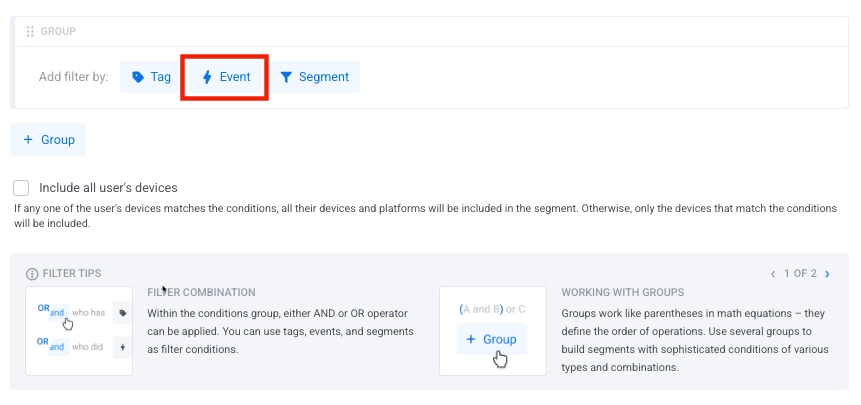
1. Hit **Event** in the **Add filter by** section.
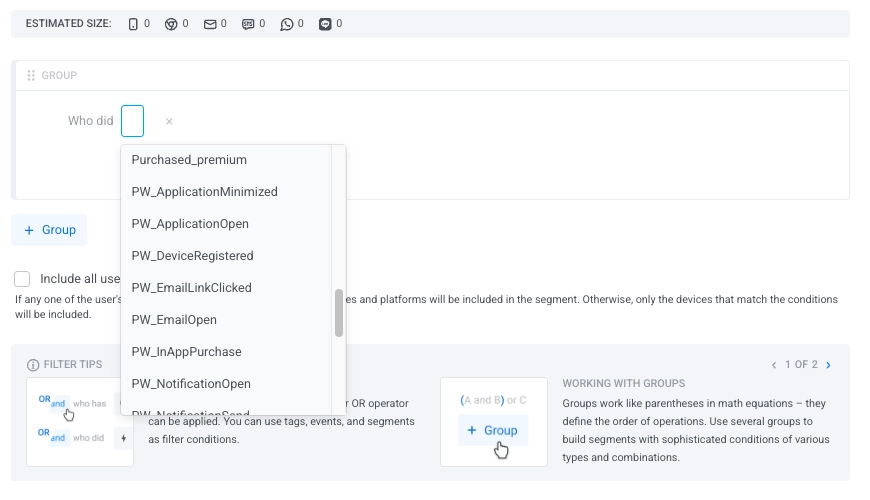
2. Select an event from the drop-down list.
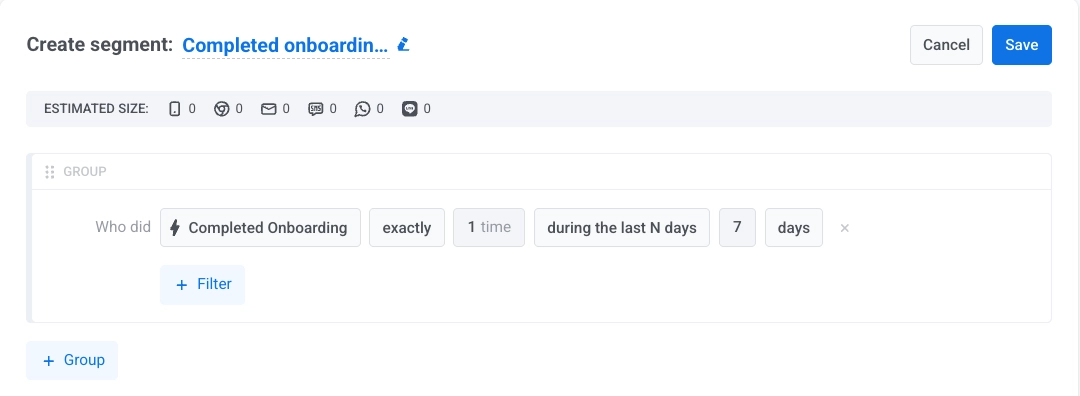
3. Indicate conditions for the selected event: the number of times it happened and a time frame.
> When specifying a time frame for your segment, you can choose from two categories: **Relative dates** and **Specific dates**.
##### Relative dates
Use these options for dynamically updating time windows based on the current date:
| | |
|-----------------------------|-------------------------------------------------------------------------|
| **during the last N days** | Includes events that occurred within the past N days |
| **exactly N days ago** | Targets users who triggered the event exactly N days ago |
| **N or more days ago** | Includes users who triggered the event at least N days ago |
| **between N and M days ago**| Defines a range of days before today |
| **between N and M days ahead**| Defines a range from N to M days from today, where 0 means today. Both N and M are included |
##### Specific dates
Use these options to define fixed calendar-based filters:
| | |
|-------------------------------|-----------------------------------------------------------------------------------|
| **on a specific date** | Includes users who triggered the event on a selected calendar date |
| **on or after a specific date** | Includes users who triggered the event starting from the selected date onward |
| **on or before a specific date**| Includes users who triggered the event up to and including the selected date |
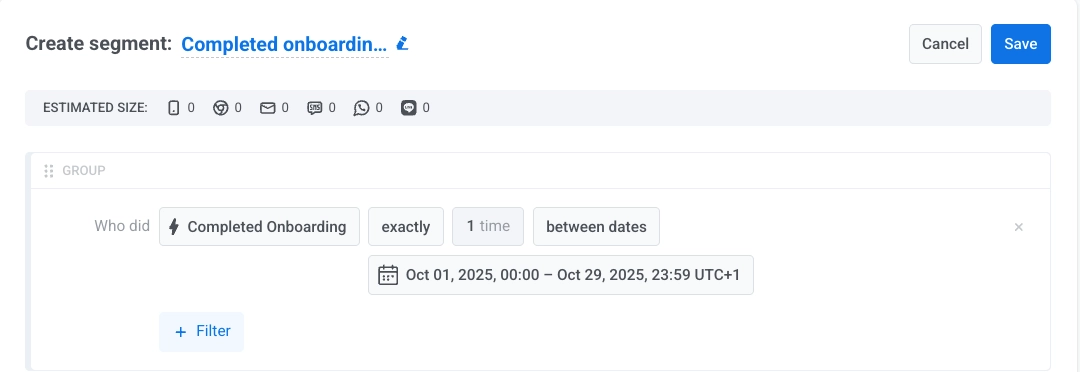
| **between dates** | Includes users who triggered the event between two specific calendar dates |
4. (Optional) Click **+ Attribute** to narrow the condition down to a specific event attribute. Select the attribute from the dropdown, choose an operator, and specify a value. Start typing to search suggested values based on previously recorded data.
See [event attribute operators by type](#event-attribute-operators-by-type) for the full list of available operators.
5. If you set several events as a segment condition, select an operator you'd like to use (AND/OR).
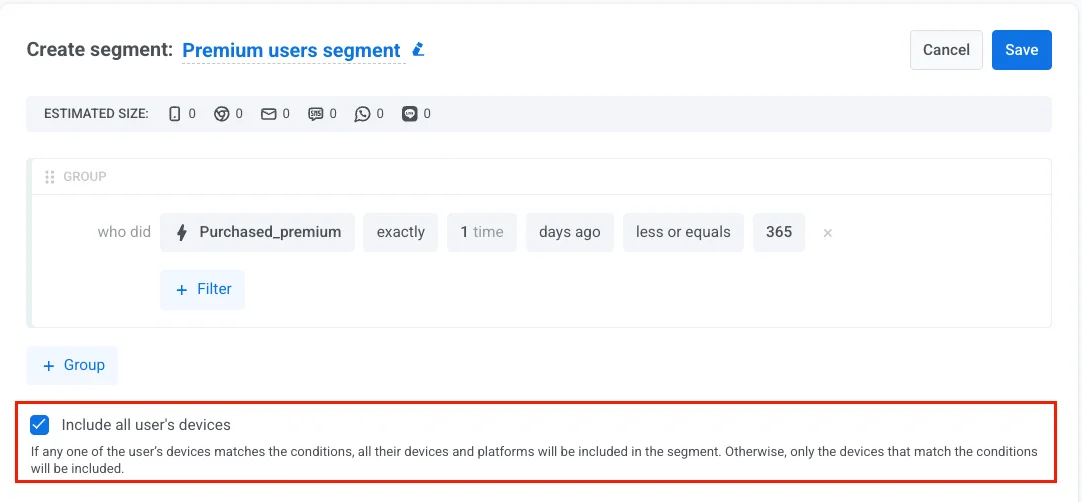
6. Include all user devices
Enable this option to target a user across all their devices, not just the one that matched the segment condition. This ensures they receive your messages on every platform they use.
* **Enabled**: If any of the user's devices meet the condition (for example, purchase event, tag, behavior), all their devices across platforms are included in the segment.
* **Disabled**: Only the devices that meet the condition are included in the segment.
## Event attribute operators by type
The available operators depend on the type of the event attribute you're filtering by. Select a type below to see its operators.
| Operator | Description | Example |
| --- | --- | --- |
| **is** | Attribute value equals the specified value | `button_name is "checkout"` |
| **is not** | Attribute value does not equal the specified value | `url is not "/cart"` |
| **starts with** | Attribute value begins with the specified string | `url starts with "https://example.com"` |
| **ends with** | Attribute value ends with the specified string | `url ends with ".html"` |
| **contains** | Attribute value contains the specified string | `url contains "/products/"` |
| **in** | Attribute value matches any value in a provided list | `button_name in ["submit", "cancel"]` |
| **not in** | Attribute value does not match any value in a provided list | `category not in ["spam", "test"]` |
| **not set** | No value was recorded for the attribute | `coupon_code not set` |
| **any** | Attribute has any recorded value | `referrer any` |
| Operator | Description | Example |
| --- | --- | --- |
| **is** | Attribute value equals the specified number | `level_number is 5` |
| **is not** | Attribute value does not equal the specified number | `score is not 0` |
| **greater or equals** | Attribute value is greater than or equal to the specified number | `points_earned greater or equals 100` |
| **less or equals** | Attribute value is less than or equal to the specified number | `attempts less or equals 3` |
| **between** | Attribute value is within the specified range (inclusive) | `level_number between 10 and 20` |
| **in** | Attribute value matches any value in the list | `level_number in [5, 10, 15]` |
| **not in** | Attribute value does not match any value in the list | `attempts not in [0, 1]` |
| **not set** | No value was recorded for the attribute | `score not set` |
| **any** | Attribute has any recorded value | `level_number any` |
| Operator | Description | Example |
| --- | --- | --- |
| **is true** | Attribute value is true | `enabled is true` |
| **is false** | Attribute value is false | `is_trial is false` |
| **not set** | No value was recorded for the attribute | `enabled not set` |
| **any** | Attribute has any recorded value (true or false) | `is_trial any` |
Use this type for monetary values with decimals. In the Control Panel it appears as **decimal (price)** when you create or edit an event attribute.
| Operator | Description | Example |
| --- | --- | --- |
| **is** | Attribute value equals the specified price | `total_price is 9.99` |
| **is not** | Attribute value does not equal the specified price | `total_price is not 0` |
| **greater or equals** | Attribute value is greater than or equal to a price | `total_price greater or equals 50.00` |
| **less or equals** | Attribute value is less than or equal to a price | `total_price less or equals 100.00` |
| **between** | Attribute value falls within the specified price range (inclusive) | `total_price between 10.00 and 50.00` |
| **in** | Attribute value matches any value in a list | `total_price in [9.99, 14.99, 19.99]` |
| **not in** | Attribute value does not match any value in a list | `total_price not in [0, 5]` |
| **not set** | No value was recorded for the attribute | `total_price not set` |
| **any** | Attribute has any recorded value | `total_price any` |
List-type attributes can hold multiple values at once, such as product IDs added to a cart.
| Operator | Description | Example |
| --- | --- | --- |
| **in** | Attribute contains at least one of the specified values | `product_ids in ["prod-123", "prod-456"]` |
| **not in** | Attribute does not contain any of the specified values | `product_ids not in ["prod-789"]` |
| **not set** | No value was recorded for the attribute | `product_ids not set` |
| **any** | Attribute has any recorded value | `product_ids any` |
Date-type attributes support the same [relative](#relative-dates) and [specific date](#specific-dates) comparisons used for the event's own time frame.
## Event-based segmentation examples
Below are several practical scenarios illustrating how you can use event filters to create meaningful audience segments.
##### Frequent purchasers
**Goal:** Target highly engaged users who have made multiple purchases recently.
**How to set up:**
- **Event:** `Purchase_made`
- **Condition:** exactly or more
- **Times:** `3`
- **Time frame:** during the last N days
- **Value:** `30`
**Use case:** Send special offers or loyalty rewards to users who demonstrate frequent buying activity.
##### High-value single purchase
**Goal:** Target users who made a large purchase, regardless of how often they buy.
**How to set up:**
- **Event:** `Purchase_made`
- **Condition:** exactly or more
- **Times:** `1`
- **Time frame:** during the last N days
- **Time frame value:** `30`
- **Attribute:** `total_price`
- **Operator:** greater or equals
- **Attribute value:** `50`
**Use case:** Invite big spenders to a loyalty or VIP program right after a qualifying purchase.
##### Viewed products but no purchase
**Goal:** Identify users who have shown interest but have not converted.
**How to set up:**
- **Event 1:** `Product_Viewed`
- **Condition:** exactly or more
- **Times:** `1`
- **Time frame:** during the last N days
- **Value:** `7`
- **Event 2:** `Purchase_made`
- **Condition:** never
- **Time frame:** during the last N days
- **Value:** `7`
- **Operator:** AND
**Use case:** Send reminders, special offers, or personalized messages to users who browsed products but haven't made a purchase yet.
##### Users engaged during a campaign
**Goal:** Target users who participated during a specific promotional period.
**How to set up:**
- **Event:** `Promotion_Click`
- **Condition:** exactly or more
- **Times:** `1`
- **Time frame:** between dates
- **Value:** `"2024-01-01"` and `"2024-01-31"`
**Use case:** Follow up with users who interacted with a past campaign to promote a related offer or gather feedback.
##### High-value actions over time
**Goal:** Identify users who performed a valuable event a certain number of times within a custom date range.
**How to set up:**
- **Event:** `Subscription_Renewal`
- **Condition:** exactly or more
- **Times:** `2`
- **Time frame:** between dates
- **Value:** `"2024-01-01"` and `"2024-12-31"`
**Use case:** Offer special recognition or advanced features to loyal subscribers who regularly renew their subscriptions.
## Tips for event-based segmentation
- Use [relative dates](#relative-dates) for ongoing campaigns that should stay updated with current user activity.
- Narrow an event condition down with an [event attribute filter](#event-attribute-operators-by-type) (e.g., purchase amount, product category) instead of relying on event occurrence alone.
- Combine event filters with other criteria such as [tags](/product/audience-data-and-segmentation/segmentation/create-segments/by-tags/) (e.g., user demographics, subscription status) or [existing segments](/product/audience-data-and-segmentation/segmentation/create-segments/by-existing-segments/) for more precise targeting. For example, you can filter users based on both event occurrence and user properties stored in tags to tailor your messaging even further.
- Periodically review and update your segment filters to adapt to changing user behaviors or business goals.
 ##### Specific dates
Use these options to define fixed calendar-based filters:
| | |
|-------------------------------|-----------------------------------------------------------------------------------|
| **on a specific date** | Includes users who triggered the event on a selected calendar date |
| **on or after a specific date** | Includes users who triggered the event starting from the selected date onward |
| **on or before a specific date**| Includes users who triggered the event up to and including the selected date |
| **between dates** | Includes users who triggered the event between two specific calendar dates |
##### Specific dates
Use these options to define fixed calendar-based filters:
| | |
|-------------------------------|-----------------------------------------------------------------------------------|
| **on a specific date** | Includes users who triggered the event on a selected calendar date |
| **on or after a specific date** | Includes users who triggered the event starting from the selected date onward |
| **on or before a specific date**| Includes users who triggered the event up to and including the selected date |
| **between dates** | Includes users who triggered the event between two specific calendar dates |
 4. (Optional) Click **+ Attribute** to narrow the condition down to a specific event attribute. Select the attribute from the dropdown, choose an operator, and specify a value. Start typing to search suggested values based on previously recorded data.
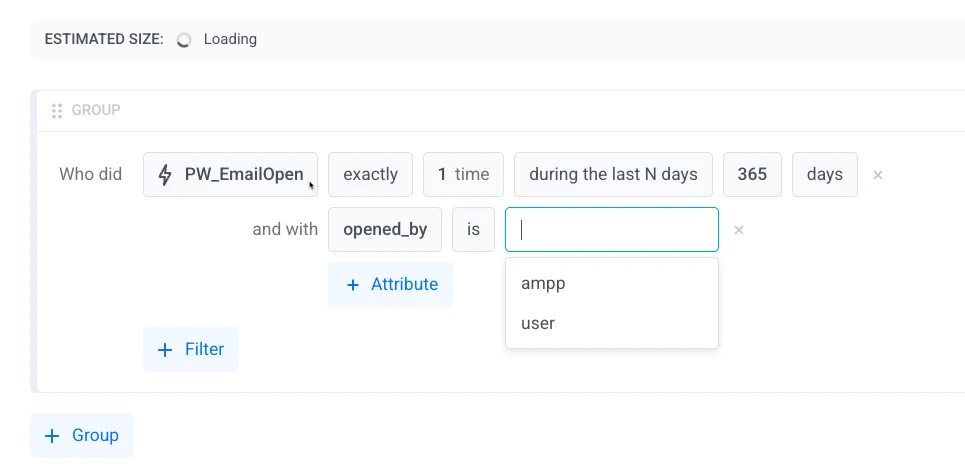 See [event attribute operators by type](#event-attribute-operators-by-type) for the full list of available operators.
5. If you set several events as a segment condition, select an operator you'd like to use (AND/OR).
6. Include all user devices
Enable this option to target a user across all their devices, not just the one that matched the segment condition. This ensures they receive your messages on every platform they use.
* **Enabled**: If any of the user's devices meet the condition (for example, purchase event, tag, behavior), all their devices across platforms are included in the segment.
* **Disabled**: Only the devices that meet the condition are included in the segment.
See [event attribute operators by type](#event-attribute-operators-by-type) for the full list of available operators.
5. If you set several events as a segment condition, select an operator you'd like to use (AND/OR).
6. Include all user devices
Enable this option to target a user across all their devices, not just the one that matched the segment condition. This ensures they receive your messages on every platform they use.
* **Enabled**: If any of the user's devices meet the condition (for example, purchase event, tag, behavior), all their devices across platforms are included in the segment.
* **Disabled**: Only the devices that meet the condition are included in the segment.
 ## Event attribute operators by type
The available operators depend on the type of the event attribute you're filtering by. Select a type below to see its operators.
## Event attribute operators by type
The available operators depend on the type of the event attribute you're filtering by. Select a type below to see its operators.