# Mac OS X
[**Descargar SDK**](https://github.com/Pushwoosh/pushwoosh-mac-sdk)\
[**Proyecto de Ejemplo**](https://github.com/Pushwoosh/pushwoosh-mac-sdk/tree/master/Samples/Mac)\
[**Documentación de la API del SDK**](https://github.com/Pushwoosh/pushwoosh-mac-sdk/tree/master/Documentation)
## Vinculando Pushwoosh.framework
Añade `Pushwoosh.framework` a tu proyecto a través de un gestor de dependencias poniendo las siguientes líneas en tu `podfile` o `cartfile`:
```
platform :osx, '10.7'
target 'MyApp' do
pod 'Pushwoosh_mac'
end
```
```
github "Pushwoosh/pushwoosh-mac-sdk"
```
Alternativamente, puedes simplemente arrastrar y soltar el framework en **Link Binaries With Libraries** en las **Build Phases** de tu proyecto.
## Añadiendo librerías
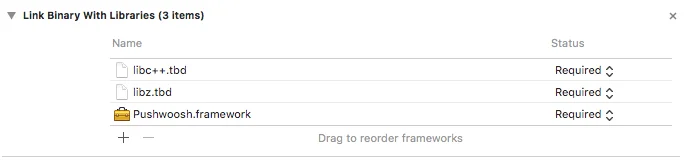
En la pestaña **Build Phases** de tu proyecto, abre **Link Binaries With Libraries** y haz clic en Add items (botón "+"). Busca y añade las librerías **libz.tbd** y **libc++.tbd** a tu proyecto:
 ## Vinculando la aplicación con el Panel de Control de Pushwoosh
En tu **Info.plist**, añade una clave de tipo string `Pushwoosh_APPID` con tu Código de Aplicación de Pushwoosh como valor.
## Modificando el AppDelegate
Añade el siguiente código a tu AppDelegate:
```swift
import PushKit
import Pushwoosh
func application(_ application: UIApplication, didFinishLaunchingWithOptions launchOptions: [UIApplicationLaunchOptionsKey : Any]? = nil) -> Bool {
//lots of your initialization code
//-----------PUSHWOOSH PART-----------
NSUserNotificationCenter.default.delegate = Pushwoosh.sharedInstance()?.notificationCenterDelegateProxy
// set custom delegate for push handling, in our case - view controller
Pushwoosh.sharedInstance().delegate = self
// handling push on app start
Pushwoosh.sharedInstance().handlePushReceived(aNotification.userInfo)
// register for push notifications!
Pushwoosh.sharedInstance().registerForPushNotifications()
```
```objective-c
#import
- (void)applicationDidFinishLaunching:(NSNotification *)aNotification
{
//lots of your initialization code
//-----------PUSHWOOSH PART-----------
[NSUserNotificationCenter defaultUserNotificationCenter].delegate = [Pushwoosh sharedInstance].notificationCenterDelegateProxy;
// set custom delegate for push handling, in our case - view controller
[Pushwoosh sharedInstance].delegate = self;
// handling push on app start
[[Pushwoosh sharedInstance] handlePushReceived:[aNotification userInfo]];
// register for push notifications!
[[Pushwoosh sharedInstance] registerForPushNotifications];
}
```
Añade el siguiente código a tu **UIApplicationDelegate** (mismo archivo que el anterior).
```swift
// system push notification registration success callback, delegate to PWMessagingDelegate
func application(_ application: NSApplication, didRegisterForRemoteNotificationsWithDeviceToken deviceToken: Data) {
Pushwoosh.sharedInstance()?.handlePushRegistration(deviceToken)
}
// system push notification registration error callback, delegate to PWMessagingDelegate
func application(_ application: NSApplication, didFailToRegisterForRemoteNotificationsWithError error: Error) {
Pushwoosh.sharedInstance()?.handlePushRegistrationFailure(error)
}
```
```objective-c
// system push notification registration success callback, delegate to pushManager
- (void)application:(NSApplication *)application didRegisterForRemoteNotificationsWithDeviceToken:(NSData *)deviceToken {
[[Pushwoosh sharedInstance] handlePushRegistration:deviceToken];
}
// system push notification registration error callback, delegate to pushManager
- (void)application:(NSApplication *)application didFailToRegisterForRemoteNotificationsWithError:(NSError *)error {
[[Pushwoosh sharedInstance] handlePushRegistrationFailure:error];
}
```
Para gestionar las notificaciones push, añade la siguiente función a tu **UIApplicationDelegate** (el mismo archivo que en los tres pasos anteriores):
```swift
//this event is fired when the push gets received
func pushwoosh(_ pushwoosh: Pushwoosh!, onMessageReceived message: PWMessage!) {
print("onMessageReceived: \(String(describing: message.payload))")
}
//this event is fired when user taps the notification
func pushwoosh(_ pushwoosh: Pushwoosh!, onMessageOpened message: PWMessage!) {
print("onMessageOpened: \(String(describing: message.payload))")
}
```
```objective-c
//this event is fired when the push gets received
- (void)pushwoosh:(Pushwoosh *)pushwoosh onMessageReceived:(PWMessage *)message {
NSLog(@"onMessageReceived: %@", message.payload);
}
//this event is fired when user taps the notification
- (void)pushwoosh:(Pushwoosh *)pushwoosh onMessageOpened:(PWMessage *)message {
NSLog(@"onMessageOpened: %@", message.payload);
}
```
## Habilitando las Notificaciones Push
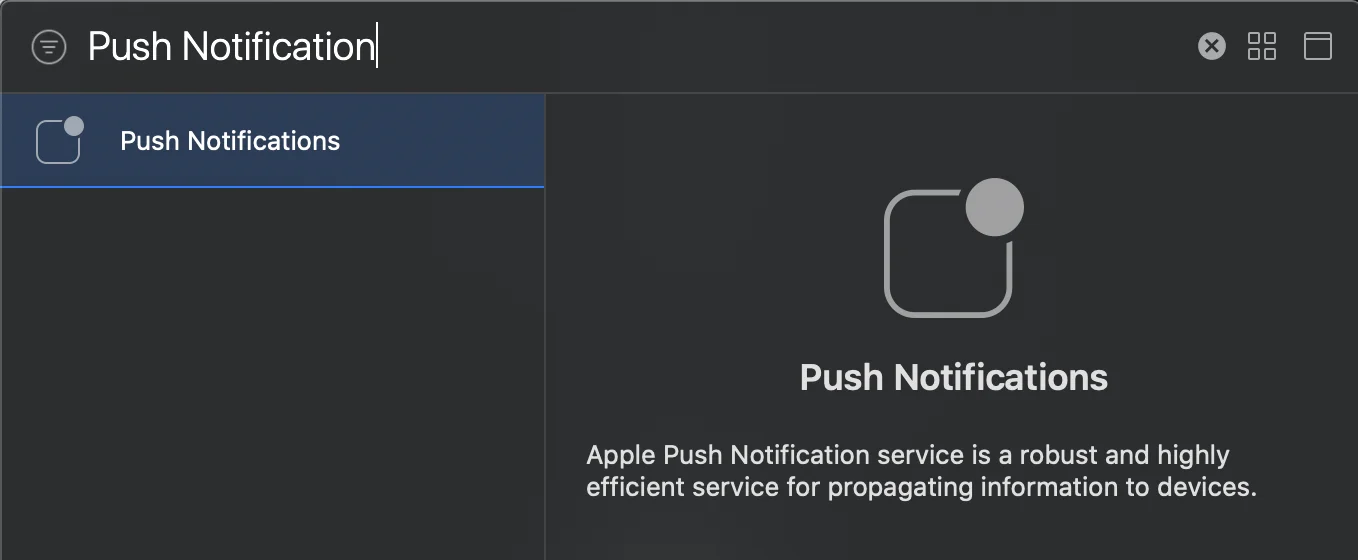
Ve a **Signing and** **Capabilities** en tu target. Pulsa **+ Capability** y añade **Push Notifications**.
## Vinculando la aplicación con el Panel de Control de Pushwoosh
En tu **Info.plist**, añade una clave de tipo string `Pushwoosh_APPID` con tu Código de Aplicación de Pushwoosh como valor.
## Modificando el AppDelegate
Añade el siguiente código a tu AppDelegate:
```swift
import PushKit
import Pushwoosh
func application(_ application: UIApplication, didFinishLaunchingWithOptions launchOptions: [UIApplicationLaunchOptionsKey : Any]? = nil) -> Bool {
//lots of your initialization code
//-----------PUSHWOOSH PART-----------
NSUserNotificationCenter.default.delegate = Pushwoosh.sharedInstance()?.notificationCenterDelegateProxy
// set custom delegate for push handling, in our case - view controller
Pushwoosh.sharedInstance().delegate = self
// handling push on app start
Pushwoosh.sharedInstance().handlePushReceived(aNotification.userInfo)
// register for push notifications!
Pushwoosh.sharedInstance().registerForPushNotifications()
```
```objective-c
#import
- (void)applicationDidFinishLaunching:(NSNotification *)aNotification
{
//lots of your initialization code
//-----------PUSHWOOSH PART-----------
[NSUserNotificationCenter defaultUserNotificationCenter].delegate = [Pushwoosh sharedInstance].notificationCenterDelegateProxy;
// set custom delegate for push handling, in our case - view controller
[Pushwoosh sharedInstance].delegate = self;
// handling push on app start
[[Pushwoosh sharedInstance] handlePushReceived:[aNotification userInfo]];
// register for push notifications!
[[Pushwoosh sharedInstance] registerForPushNotifications];
}
```
Añade el siguiente código a tu **UIApplicationDelegate** (mismo archivo que el anterior).
```swift
// system push notification registration success callback, delegate to PWMessagingDelegate
func application(_ application: NSApplication, didRegisterForRemoteNotificationsWithDeviceToken deviceToken: Data) {
Pushwoosh.sharedInstance()?.handlePushRegistration(deviceToken)
}
// system push notification registration error callback, delegate to PWMessagingDelegate
func application(_ application: NSApplication, didFailToRegisterForRemoteNotificationsWithError error: Error) {
Pushwoosh.sharedInstance()?.handlePushRegistrationFailure(error)
}
```
```objective-c
// system push notification registration success callback, delegate to pushManager
- (void)application:(NSApplication *)application didRegisterForRemoteNotificationsWithDeviceToken:(NSData *)deviceToken {
[[Pushwoosh sharedInstance] handlePushRegistration:deviceToken];
}
// system push notification registration error callback, delegate to pushManager
- (void)application:(NSApplication *)application didFailToRegisterForRemoteNotificationsWithError:(NSError *)error {
[[Pushwoosh sharedInstance] handlePushRegistrationFailure:error];
}
```
Para gestionar las notificaciones push, añade la siguiente función a tu **UIApplicationDelegate** (el mismo archivo que en los tres pasos anteriores):
```swift
//this event is fired when the push gets received
func pushwoosh(_ pushwoosh: Pushwoosh!, onMessageReceived message: PWMessage!) {
print("onMessageReceived: \(String(describing: message.payload))")
}
//this event is fired when user taps the notification
func pushwoosh(_ pushwoosh: Pushwoosh!, onMessageOpened message: PWMessage!) {
print("onMessageOpened: \(String(describing: message.payload))")
}
```
```objective-c
//this event is fired when the push gets received
- (void)pushwoosh:(Pushwoosh *)pushwoosh onMessageReceived:(PWMessage *)message {
NSLog(@"onMessageReceived: %@", message.payload);
}
//this event is fired when user taps the notification
- (void)pushwoosh:(Pushwoosh *)pushwoosh onMessageOpened:(PWMessage *)message {
NSLog(@"onMessageOpened: %@", message.payload);
}
```
## Habilitando las Notificaciones Push
Ve a **Signing and** **Capabilities** en tu target. Pulsa **+ Capability** y añade **Push Notifications**.