# دليل التكامل الأساسي لـ iOS SDK 7.0+
يحتوي هذا القسم على معلومات حول كيفية دمج Pushwoosh SDK في تطبيق iOS الخاص بك.
## المتطلبات الأساسية
لدمج Pushwoosh iOS SDK في تطبيقك، ستحتاج إلى ما يلي:
## خطوات التكامل
### 1. التثبيت
يمكنك دمج Pushwoosh SDK في تطبيقك باستخدام **Swift Package Manager** أو **CocoaPods**.
#### Swift Package Manager
في قسم **Package Dependencies**، أضف الحزمة التالية:
```
https://github.com/Pushwoosh/Pushwoosh-XCFramework
```
لاستخدام Pushwoosh iOS SDK، تأكد من إضافة الأطر الثلاثة التالية إلى هدف تطبيقك عند التكامل عبر Swift Package Manager:
* ```PushwooshFramework```
* ```PushwooshCore```
* ```PushwooshBridge```
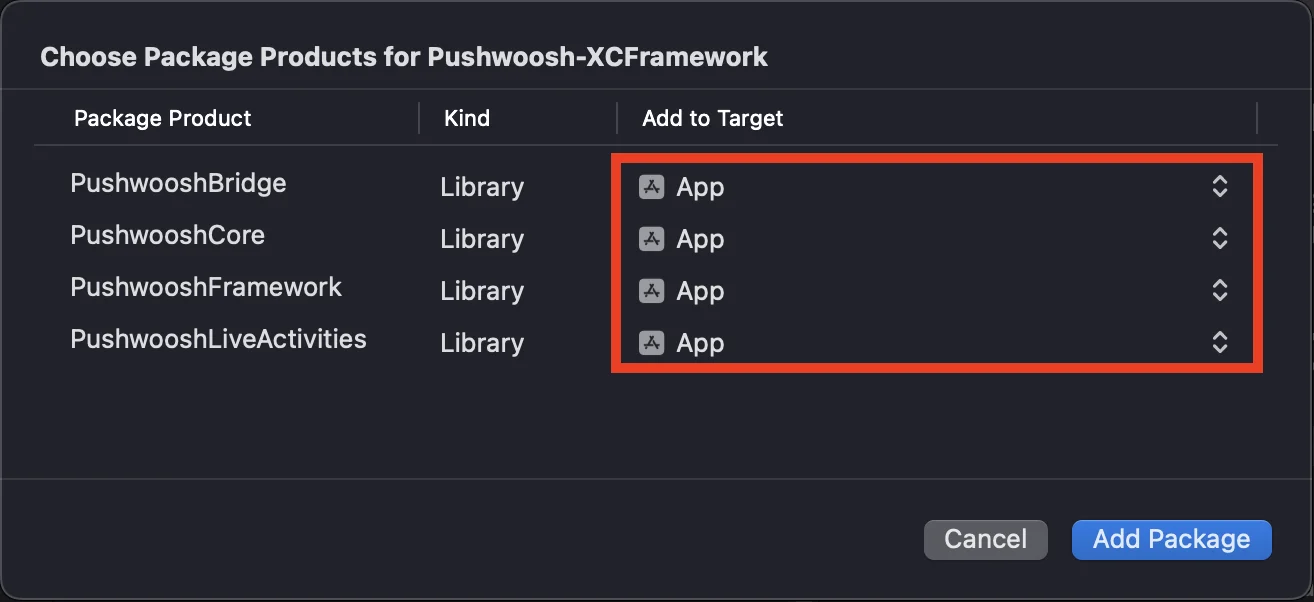 #### CocoaPods
افتح ملف `Podfile` الخاص بك وأضف التبعية:
```bash
# Uncomment the next line to define a global platform for your project
# platform :ios, '9.0'
target 'MyApp' do
# Comment the next line if you don't want to use dynamic frameworks
use_frameworks!
pod 'PushwooshXCFramework'
end
```
بعد ذلك، في الطرفية (terminal)، قم بتشغيل الأمر التالي لتثبيت التبعيات:
```bash
pod install
```
### 2. الإمكانيات (Capabilities)
لتمكين الإشعارات الفورية في مشروعك، تحتاج إلى إضافة إمكانيات معينة.
في قسم Signing & Capabilities، أضف الإمكانيات التالية:
- `Push Notifications`
- `Background Modes`. بعد إضافة هذه الإمكانية، حدد مربع `Remote notifications`.
إذا كنت تنوي استخدام الإشعارات الحساسة للوقت (Time Sensitive Notifications) (iOS 15+)، فأضف أيضًا إمكانية `Time Sensitive Notifications`.
### 3. كود التهيئة
#### AppDelegate
أضف الكود التالي إلى فئة AppDelegate الخاصة بك:
```swift
import SwiftUI
import PushwooshFramework
@main
struct MyApp: App {
// Register AppDelegate as UIApplicationDelegate
@UIApplicationDelegateAdaptor(AppDelegate.self) var appDelegate
var body: some Scene {
WindowGroup {
ContentView()
}
}
}
class AppDelegate: NSObject, UIApplicationDelegate, PWMessagingDelegate {
func application(_ application: UIApplication, didFinishLaunchingWithOptions launchOptions: [UIApplication.LaunchOptionsKey: Any]?) -> Bool {
// Initialization code
// Set custom delegate for push handling
Pushwoosh.configure.delegate = self
// Register for push notifications
Pushwoosh.configure.registerForPushNotifications()
return true
}
// Handle token received from APNS
func application(_ application: UIApplication, didRegisterForRemoteNotificationsWithDeviceToken deviceToken: Data) {
Pushwoosh.configure.handlePushRegistration(deviceToken)
}
// Handle token receiving error
func application(_ application: UIApplication, didFailToRegisterForRemoteNotificationsWithError error: Error) {
Pushwoosh.configure.handlePushRegistrationFailure(error)
}
//for silent push notifications
func application(_ application: UIApplication, didReceiveRemoteNotification userInfo: [AnyHashable: Any], fetchCompletionHandler completionHandler: @escaping (UIBackgroundFetchResult) -> Void) {
Pushwoosh.configure.handlePushReceived(userInfo)
completionHandler(.noData)
}
// Fired when a push is received
func pushwoosh(_ pushwoosh: Pushwoosh, onMessageReceived message: PWMessage) {
print("onMessageReceived: ", message.payload!.description)
}
// Fired when a user taps the notification
func pushwoosh(_ pushwoosh: Pushwoosh, onMessageOpened message: PWMessage) {
print("onMessageOpened: ", message.payload!.description)
}
}
struct ContentView: View {
var body: some View {
Text("Pushwoosh with SwiftUI")
.padding()
}
}
```
```swift
import PushwooshFramework
@UIApplicationMain
class AppDelegate: UIResponder, UIApplicationDelegate, PWMessagingDelegate {
var window: UIWindow?
func application(_ application: UIApplication, didFinishLaunchingWithOptions launchOptions: [UIApplication.LaunchOptionsKey: Any]?) -> Bool {
//initialization code
//set custom delegate for push handling, in our case AppDelegate
Pushwoosh.configure.delegate = self;
//register for push notifications
Pushwoosh.configure.registerForPushNotifications()
return true
}
//handle token received from APNS
func application(_ application: UIApplication, didRegisterForRemoteNotificationsWithDeviceToken deviceToken: Data) {
Pushwoosh.configure.handlePushRegistration(deviceToken)
}
//handle token receiving error
func application(_ application: UIApplication, didFailToRegisterForRemoteNotificationsWithError error: Error) {
Pushwoosh.configure.handlePushRegistrationFailure(error);
}
//for silent push notifications
func application(_ application: UIApplication, didReceiveRemoteNotification userInfo: [AnyHashable : Any], fetchCompletionHandler completionHandler: @escaping (UIBackgroundFetchResult) -> Void) {
Pushwoosh.configure.handlePushReceived(userInfo)
completionHandler(.noData)
}
//this event is fired when the push gets received
func pushwoosh(_ pushwoosh: Pushwoosh, onMessageReceived message: PWMessage) {
print("onMessageReceived: ", message.payload!.description)
}
// Fired when a user taps the notification
func pushwoosh(_ pushwoosh: Pushwoosh, onMessageOpened message: PWMessage) {
print("onMessageOpened: ", message.payload!.description)
}
}
```
```objective-c
#import
@implementation AppDelegate
- (BOOL)application:(UIApplication *)application didFinishLaunchingWithOptions:(NSDictionary *)launchOptions {
//-----------PUSHWOOSH PART-----------
// set custom delegate for push handling, in our case AppDelegate
[Pushwoosh configure].delegate = self;
//register for push notifications!
[[Pushwoosh configure] registerForPushNotifications];
return YES;
}
//handle token received from APNS
- (void)application:(UIApplication *)application
didRegisterForRemoteNotificationsWithDeviceToken:(NSData *)deviceToken {
[[Pushwoosh configure] handlePushRegistration:deviceToken];
}
//handle token receiving error
- (void)application:(UIApplication *)application didFailToRegisterForRemoteNotificationsWithError:(NSError *)error {
[[Pushwoosh configure] handlePushRegistrationFailure:error];
}
//for silent push notifications
- (void)application:(UIApplication *)application
didReceiveRemoteNotification:(NSDictionary *)userInfo
fetchCompletionHandler:(void (^)(UIBackgroundFetchResult))completionHandler {
[[Pushwoosh configure] handlePushReceived:userInfo];
completionHandler(UIBackgroundFetchResultNoData);
}
//this event is fired when the push gets received
- (void)pushwoosh:(Pushwoosh *)pushwoosh onMessageReceived:(PWMessage *)message {
NSLog(@"onMessageReceived: %@", message.payload);
}
//this event is fired when user taps the notification
- (void)pushwoosh:(Pushwoosh *)pushwoosh onMessageOpened:(PWMessage *)message {
NSLog(@"onMessageOpened: %@", message.payload);
}
@end
```
#### Info.plist
في ملف `Info.plist` الخاص بك:
- قم بتعيين مفتاح `Pushwoosh_APPID` إلى كود تطبيق Pushwoosh.
- قم بتعيين مفتاح `Pushwoosh_API_TOKEN` إلى [Pushwoosh Device API Token](/ar/developer/api-reference/api-access-token/#device-api-token)
### 4. تتبع تسليم الرسائل
يدعم Pushwoosh تتبع أحداث التسليم للإشعارات الفورية عبر Notification Service Extension
#### إضافة Notification Service Extension
1. في Xcode، حدد **File** > **New** > **Target...**
2. اختر **Notification Service Extension** واضغط على **Next.**
3. أدخل اسم الهدف واضغط على **Finish.**
4. عند المطالبة بالتفعيل، اضغط على **Cancel.**
#### التبعيات لـ Notification Service Extension (لـ CocoaPods فقط)
ملاحظة: إذا كنت تستخدم Swift Package Manager لإدارة التبعيات، يمكنك تخطي هذه الخطوة، حيث تتم إضافة التبعيات تلقائيًا.
افتح ملف `Podfile` الخاص بك وأضف التبعية للهدف:
```ruby title="Podfile"
# Uncomment the next line to define a global platform for your project
# platform :ios, '9.0'
target 'MyApp' do
# Comment the next line if you don't want to use dynamic frameworks
use_frameworks!
pod 'PushwooshXCFramework'
end
target 'MyAppNotificationExtension' do
use_frameworks!
pod 'PushwooshXCFramework'
end
```
قم بتشغيل الأمر التالي في الطرفية (terminal) لتحديث التبعيات:
```shell
pod update
```
#### إضافة Pushwoosh SDK إلى Notification Service Extension
استبدل فئة `NotificationService` التي تم إنشاؤها بفئة فرعية من `PushwooshNotificationServiceExtension`. بعد ذلك، يتولى Pushwoosh كل ما يحتاجه الإشعار الفوري — إرسال حدث التسليم، وعد الشارات (badge)، وتنزيل المرفقات الوسائط، والمهلة الإلزامية `serviceExtensionTimeWillExpire`. لا يلزم أي كود آخر.
```swift
import PushwooshFramework
class NotificationService: PushwooshNotificationServiceExtension {}
```
```objective-c
#import
@interface NotificationService : PushwooshNotificationServiceExtension
@end
@implementation NotificationService
@end
```
ملاحظة: يمكنك تخطي ملف المصدر بالكامل — قم بتعيين `NSExtensionPrincipalClass` الخاص بالامتداد إلى `PushwooshNotificationServiceExtension` في ملف Info.plist الخاص به ولا تكتب أي كود على الإطلاق.
لتعديل الإشعار قبل عرضه، قم بتجاوز `didReceive(_:withContentHandler:)`، واستدعِ `super` مع معالج المحتوى الخاص بك، وقم بتعديل المحتوى بداخله، ثم قم بتمريره إلى المعالج الأصلي. سيظل Pushwoosh يقوم بتشغيل حدث التسليم، والشارة، والمرفق، والمهلة.
```swift
import UserNotifications
import PushwooshFramework
class NotificationService: PushwooshNotificationServiceExtension {
override func didReceive(_ request: UNNotificationRequest,
withContentHandler contentHandler: @escaping (UNNotificationContent) -> Void) {
super.didReceive(request) { content in
let mutable = (content.mutableCopy() as? UNMutableNotificationContent) ?? content
// Modify the notification content here...
contentHandler(mutable)
}
}
}
```
```objective-c
#import
@interface NotificationService : PushwooshNotificationServiceExtension
@end
@implementation NotificationService
- (void)didReceiveNotificationRequest:(UNNotificationRequest *)request
withContentHandler:(void (^)(UNNotificationContent * _Nonnull))contentHandler {
[super didReceiveNotificationRequest:request withContentHandler:^(UNNotificationContent *content) {
UNMutableNotificationContent *mutable = [content mutableCopy];
// Modify the notification content here...
contentHandler(mutable);
}];
}
@end
```
#### Info.plist
يرث الامتداد `Pushwoosh_APPID` (ومفاتيح `Pushwoosh_*` الأخرى) من التطبيق المضيف، لذلك لا تحتاج إلى تكرارها في ملف Info.plist الخاص بالامتداد. أضف مفتاحًا هناك فقط عندما تريد تجاوز قيمة المضيف.
لمزامنة عدد الشارات وإعدادات الوكيل العكسي مع التطبيق، شارك [App Group](/ar/developer/pushwoosh-sdk/ios-sdk/setting-up-badges) بين التطبيق والامتداد. أضف إمكانية App Groups إلى كلا الهدفين، ثم قم بتعيين معرف App Group في ملف Info.plist الخاص بـ **التطبيق الرئيسي**:
- `PW_APP_GROUPS_NAME` - معرف App Group الخاص بك (على سبيل المثال، `group.com.example.app`).
يرث الامتداد هذه القيمة من التطبيق المضيف، لذلك لا تحتاج إلى تكرارها في ملف Info.plist الخاص بالامتداد — أضفها هناك فقط لتجاوز المضيف. بدلاً من ذلك، قم بتوفيرها في الكود عن طريق تجاوز `pushwooshAppGroupsName`.
### 5. تشغيل المشروع
1. قم ببناء وتشغيل المشروع.
2. انتقل إلى لوحة تحكم Pushwoosh و[أرسل إشعارًا فوريًا](/ar/product/messaging-channels/push-notifications/send-push-notifications/one-time-push).
3. يجب أن ترى الإشعار في التطبيق.
## تكامل Pushwoosh iOS الممتد
في هذه المرحلة، تكون قد قمت بالفعل بدمج SDK ويمكنك إرسال واستقبال الإشعارات الفورية. الآن، دعنا نستكشف الوظائف الأساسية
### الإشعارات الفورية
في Pushwoosh SDK، هناك استدعاءان (callbacks) مصممان للتعامل مع الإشعارات الفورية:
- `onMessageReceived`: يتم استدعاء هذه الطريقة عند استلام إشعار فوري.
- `onMessageOpened`: يتم استدعاء هذه الطريقة عندما يتفاعل المستخدم مع الإشعار (يفتحه)
تمكّن هذه الاستدعاءات المطورين من إدارة استقبال الإشعارات الفورية وتفاعل المستخدم معها داخل تطبيقاتهم
```swift
import PushwooshFramework
class AppDelegate: NSObject, UIApplicationDelegate, PWMessagingDelegate {
func application(_ application: UIApplication, didFinishLaunchingWithOptions launchOptions: [UIApplication.LaunchOptionsKey : Any]? = nil) -> Bool {
Pushwoosh.configure.delegate = self;
}
func pushwoosh(_ pushwoosh: Pushwoosh, onMessageOpened message: PWMessage) {
if let payload = message.payload {
print("onMessageOpened: \(payload)")
}
}
func pushwoosh(_ pushwoosh: Pushwoosh, onMessageReceived message: PWMessage) {
if let payload = message.payload {
print("onMessageReceived: \(payload)")
}
}
}
```
```objective-c
#import
@interface AppDelegate ()
@end
@implementation AppDelegate
- (BOOL)application:(UIApplication *)application didFinishLaunchingWithOptions:(NSDictionary *)launchOptions {
[[Pushwoosh configure] setDelegate:self];
return YES;
}
- (void)pushwoosh:(Pushwoosh *)pushwoosh onMessageOpened:(PWMessage *)message {
if (message.payload) {
NSLog(@"onMessageOpened: %@", message.payload);
}
}
- (void)pushwoosh:(Pushwoosh *)pushwoosh onMessageReceived:(PWMessage *)message {
if (message.payload) {
NSLog(@"onMessageReceived: %@", message.payload);
}
}
@end
```
### تكوين المستخدم
من خلال التركيز على سلوك وتفضيلات المستخدم الفردية، يمكنك تقديم محتوى مخصص، مما يؤدي إلى زيادة رضا المستخدم وولائه
```swift
import PushwooshFramework
class Registration {
func afterUserLogin(user: User) {
let pushwoosh = Pushwoosh.configure
// set user ID
if let userId = user.userId {
pushwoosh.setUserId(userId)
}
// set user email
if let userEmail = user.email {
pushwoosh.setEmail(userEmail)
}
// set user SMS number
if let userSmsNumber = user.SmsNumber {
pushwoosh.registerSmsNumber(userSmsNumber)
}
// set user WhatsApp number
if let userWhatsAppNumber = user.WhatsAppNumber {
pushwoosh.registerSmsNumber(userWhatsAppNumber)
}
// setting additional user information as tags for Pushwoosh
if let age = user.userDetails.age,
let name = user.userDetails.userName,
let lastLogin = user.userDetails.lastLoginDate {
pushwoosh.setTags([
"age": age,
"name": name,
"last_login": lastLogin
])
}
}
}
```
```objective-c
#import
@implementation Registration
- (void)afterUserLogin:(User *)user {
Pushwoosh *pushwoosh = [Pushwoosh configure];
// set user ID
if (user.userId) {
[pushwoosh setUserId:user.userId];
}
// set user email
if (user.email) {
[pushwoosh setEmail:user.email];
}
// setting additional user information as tags for Pushwoosh
if (user.userDetails.age && user.userDetails.userName && user.userDetails.lastLoginDate) {
NSDictionary *tags = @{
@"age": user.userDetails.age,
@"name": user.userDetails.userName,
@"last_login": user.userDetails.lastLoginDate
};
[pushwoosh setTags:tags];
}
}
@end
```
### العلامات (Tags)
العلامات (Tags) هي أزواج من المفاتيح والقيم يتم تعيينها للمستخدمين أو الأجهزة، مما يسمح بالتقسيم بناءً على سمات مثل التفضيلات أو السلوك، مما يتيح إرسال رسائل مستهدفة.
```swift
import PushwooshFramework
class UpdateUser {
func afterUserUpdateProfile(user: User) {
let pushwoosh = Pushwoosh.configure
// set list of favorite categories
pushwoosh.setTags(["favorite_categories" : user.getFavoriteCategories()])
// set payment information
pushwoosh.setTags([
"is_subscribed": user.isSubscribed(),
"payment_status": user.getPaymentStatus(),
"billing_address": user.getBillingAddress()
])
}
}
```
```objective-c
#import
@implementation UpdateUser
- (void)afterUserUpdateProfile:(User *)user {
Pushwoosh *pushwoosh = [Pushwoosh configure];
// set list of favorite categories
[pushwoosh setTags:@{@"favorite_categories" : user.getFavoriteCategories}];
// set payment information
NSDictionary *tags = @{
@"is_subscribed": @(user.isSubscribed),
@"payment_status": user.getPaymentStatus,
@"billing_address": user.getBillingAddress
};
[pushwoosh setTags:tags];
}
@end
```
### الأحداث (Events)
الأحداث (Events) هي إجراءات أو وقائع محددة للمستخدم داخل التطبيق يمكن تتبعها لتحليل السلوك وتشغيل الرسائل أو الإجراءات المقابلة
```swift
import PushwooshFramework
class Registration {
func afterUserLogin(user: User) {
if let userName = user.getUserName(), let lastLogin = user.getLastLoginDate() {
PWInAppManager.shared().postEvent("login", withAttributes: [
"name": userName,
"last_login": lastLogin
])
}
}
func afterUserPurchase(user: User, product: Product) {
let pushwoosh = Pushwoosh.configure
// Track purchase event
PWInAppManager.shared().postEvent("purchase", withAttributes: [
"product_id": product.getId(),
"product_name": product.getName(),
"price": product.getPrice(),
"quantity": product.getQuantity()
])
// Set user tags
let lastPurchaseDate = Date().timeIntervalSince1970
let lifetimeSpend = getCurrentLifetimeSpend() + product.getPrice()
pushwoosh.setTags([
"last_purchase_date": lastPurchaseDate,
"lifetime_spend": lifetimeSpend
])
}
}
```
```objective-c
#import
#import
@implementation Registration
- (void)afterUserLogin:(User *)user {
NSString *userName = [user getUserName];
NSDate *lastLogin = [user getLastLoginDate];
if (userName && lastLogin) {
[[PWInAppManager sharedManager] postEvent:@"login" withAttributes:@{
@"name": userName,
@"last_login": lastLogin
}];
}
}
- (void)afterUserPurchase:(User *)user product:(Product *)product {
Pushwoosh *pushwoosh = [Pushwoosh configure];
// Track purchase event
[[PWInAppManager sharedManager] postEvent:@"purchase" withAttributes:@{
@"product_id": [product getId],
@"product_name": [product getName],
@"price": @([product getPrice]),
@"quantity": @([product getQuantity])
}];
// Set user tags
NSTimeInterval lastPurchaseDate = [[NSDate date] timeIntervalSince1970];
double lifetimeSpend = /* fetch current lifetime spend */ + [product getPrice];
NSDictionary *tags = @{
@"last_purchase_date": @(lastPurchaseDate),
@"lifetime_spend": @(lifetimeSpend)
};
[pushwoosh setTags:tags];
}
@end
```
### الوسائط الغنية (Rich Media)
تشير الوسائط الغنية (Rich Media) إلى المحتوى التفاعلي والوسائط المتعددة، مثل الصور أو مقاطع الفيديو أو HTML، المستخدم في الإشعارات والرسائل داخل التطبيق لتعزيز تفاعل المستخدم
```swift
import PushwooshFramework
class ViewController: UIViewController, PWRichMediaPresentingDelegate {
override func viewDidLoad() {
super.viewDidLoad()
let richMediaConfiguration = PWModalWindowConfiguration.shared()
PWRichMediaManager.shared().delegate = self
richMediaConfiguration.configureModalWindow(with: .PWModalWindowPositionBottom,
present: .PWAnimationPresentFromBottom,
dismiss: .PWAnimationDismissDown)
}
func richMediaManager(_ richMediaManager: PWRichMediaManager!, shouldPresent richMedia: PWRichMedia!) -> Bool {
print("Rich media will be presented with: \(richMedia.pushPayload!)")
return true
}
func richMediaManager(_ richMediaManager: PWRichMediaManager!, didPresent richMedia: PWRichMedia!) {
print("Rich media has been presented with: \(richMedia.pushPayload!)")
}
func richMediaManager(_ richMediaManager: PWRichMediaManager!, didClose richMedia: PWRichMedia!) {
print("Rich media has been closed with: \(richMedia.pushPayload!)")
}
func richMediaManager(_ richMediaManager: PWRichMediaManager!, presentingDidFailFor richMedia: PWRichMedia!, withError error: (any Error)!) {
print("Failed to present rich media with: \(richMedia.pushPayload!). Error: \(error.localizedDescription)")
}
}
```
```objective-c
#import "ViewController.h"
#import
#import
#import
@interface ViewController ()
@end
@implementation ViewController
- (void)viewDidLoad {
[super viewDidLoad];
[[PWRichMediaManager sharedManager] setDelegate:self];
[[PWModalWindowConfiguration shared] configureModalWindowWith:PWModalWindowPositionBottom
presentAnimation:PWAnimationPresentFromBottom
dismissAnimation:PWAnimationDismissDown];
}
- (BOOL)richMediaManager:(PWRichMediaManager *)richMediaManager shouldPresentRichMedia:(PWRichMedia *)richMedia {
NSLog(@"Rich media will be presented with: %@", richMedia.pushPayload);
return YES;
}
- (void)richMediaManager:(PWRichMediaManager *)richMediaManager didPresentRichMedia:(PWRichMedia *)richMedia {
NSLog(@"Rich media has been presented with: %@", richMedia.pushPayload);
}
- (void)richMediaManager:(PWRichMediaManager *)richMediaManager didCloseRichMedia:(PWRichMedia *)richMedia {
NSLog(@"Rich media has been closed with:: %@", richMedia.pushPayload);
}
- (void)richMediaManager:(PWRichMediaManager *)richMediaManager presentingDidFailForRichMedia:(PWRichMedia *)richMedia withError:(NSError *)error {
NSLog(@"Failed to present rich media with: %@. Error: %@", richMedia.pushPayload, error.localizedDescription);
}
@end
```
## استكشاف الأخطاء وإصلاحها
### فشل في بناء الوحدة 'PushwooshFramework'
عند بناء مشروعك، قد تواجه خطأً مشابهًا لـ:
```
Failed to build module 'PushwooshFramework'; this SDK is not supported by the compiler
(the SDK is built with 'Apple Swift version 5.10 (swiftlang-5.10.0.13 clang-1500.3.9.4)',
while this compiler is 'Apple Swift version 6.1.2 effective-5.10 (swiftlang-6.1.2.1.2 clang-1700.0.13.5)')
```
**السبب:** هذا الخطأ لا يتعلق بعدم توافق إصدار مترجم Swift. بدءًا من إصدار Pushwoosh iOS SDK 6.8.0، تم تقسيم SDK إلى عدة مكونات تتفاعل مع بعضها البعض. يحدث الخطأ عندما لا تتم إضافة جميع الأطر المطلوبة إلى مشروعك.
**الحل:** تأكد من إضافة جميع الأطر الأربعة المطلوبة إلى هدف تطبيقك عند التكامل عبر Swift Package Manager:
* ```PushwooshFramework```
* ```PushwooshCore```
* ```PushwooshBridge```
* ```PushwooshLiveActivities```
للتحقق من ذلك في Xcode:
1. حدد مشروعك في Project Navigator
2. حدد هدف تطبيقك
3. انتقل إلى **General** > **Frameworks, Libraries, and Embedded Content**
4. تأكد من إدراج جميع الأطر الأربعة
---
إذا واجهت أي مشاكل أثناء عملية التكامل، يرجى الرجوع إلى قسم [الدعم والمجتمع](/ar/developer/pushwoosh-sdk/support-and-community).
#### CocoaPods
افتح ملف `Podfile` الخاص بك وأضف التبعية:
```bash
# Uncomment the next line to define a global platform for your project
# platform :ios, '9.0'
target 'MyApp' do
# Comment the next line if you don't want to use dynamic frameworks
use_frameworks!
pod 'PushwooshXCFramework'
end
```
بعد ذلك، في الطرفية (terminal)، قم بتشغيل الأمر التالي لتثبيت التبعيات:
```bash
pod install
```
### 2. الإمكانيات (Capabilities)
لتمكين الإشعارات الفورية في مشروعك، تحتاج إلى إضافة إمكانيات معينة.
في قسم Signing & Capabilities، أضف الإمكانيات التالية:
- `Push Notifications`
- `Background Modes`. بعد إضافة هذه الإمكانية، حدد مربع `Remote notifications`.
إذا كنت تنوي استخدام الإشعارات الحساسة للوقت (Time Sensitive Notifications) (iOS 15+)، فأضف أيضًا إمكانية `Time Sensitive Notifications`.
### 3. كود التهيئة
#### AppDelegate
أضف الكود التالي إلى فئة AppDelegate الخاصة بك:
```swift
import SwiftUI
import PushwooshFramework
@main
struct MyApp: App {
// Register AppDelegate as UIApplicationDelegate
@UIApplicationDelegateAdaptor(AppDelegate.self) var appDelegate
var body: some Scene {
WindowGroup {
ContentView()
}
}
}
class AppDelegate: NSObject, UIApplicationDelegate, PWMessagingDelegate {
func application(_ application: UIApplication, didFinishLaunchingWithOptions launchOptions: [UIApplication.LaunchOptionsKey: Any]?) -> Bool {
// Initialization code
// Set custom delegate for push handling
Pushwoosh.configure.delegate = self
// Register for push notifications
Pushwoosh.configure.registerForPushNotifications()
return true
}
// Handle token received from APNS
func application(_ application: UIApplication, didRegisterForRemoteNotificationsWithDeviceToken deviceToken: Data) {
Pushwoosh.configure.handlePushRegistration(deviceToken)
}
// Handle token receiving error
func application(_ application: UIApplication, didFailToRegisterForRemoteNotificationsWithError error: Error) {
Pushwoosh.configure.handlePushRegistrationFailure(error)
}
//for silent push notifications
func application(_ application: UIApplication, didReceiveRemoteNotification userInfo: [AnyHashable: Any], fetchCompletionHandler completionHandler: @escaping (UIBackgroundFetchResult) -> Void) {
Pushwoosh.configure.handlePushReceived(userInfo)
completionHandler(.noData)
}
// Fired when a push is received
func pushwoosh(_ pushwoosh: Pushwoosh, onMessageReceived message: PWMessage) {
print("onMessageReceived: ", message.payload!.description)
}
// Fired when a user taps the notification
func pushwoosh(_ pushwoosh: Pushwoosh, onMessageOpened message: PWMessage) {
print("onMessageOpened: ", message.payload!.description)
}
}
struct ContentView: View {
var body: some View {
Text("Pushwoosh with SwiftUI")
.padding()
}
}
```
```swift
import PushwooshFramework
@UIApplicationMain
class AppDelegate: UIResponder, UIApplicationDelegate, PWMessagingDelegate {
var window: UIWindow?
func application(_ application: UIApplication, didFinishLaunchingWithOptions launchOptions: [UIApplication.LaunchOptionsKey: Any]?) -> Bool {
//initialization code
//set custom delegate for push handling, in our case AppDelegate
Pushwoosh.configure.delegate = self;
//register for push notifications
Pushwoosh.configure.registerForPushNotifications()
return true
}
//handle token received from APNS
func application(_ application: UIApplication, didRegisterForRemoteNotificationsWithDeviceToken deviceToken: Data) {
Pushwoosh.configure.handlePushRegistration(deviceToken)
}
//handle token receiving error
func application(_ application: UIApplication, didFailToRegisterForRemoteNotificationsWithError error: Error) {
Pushwoosh.configure.handlePushRegistrationFailure(error);
}
//for silent push notifications
func application(_ application: UIApplication, didReceiveRemoteNotification userInfo: [AnyHashable : Any], fetchCompletionHandler completionHandler: @escaping (UIBackgroundFetchResult) -> Void) {
Pushwoosh.configure.handlePushReceived(userInfo)
completionHandler(.noData)
}
//this event is fired when the push gets received
func pushwoosh(_ pushwoosh: Pushwoosh, onMessageReceived message: PWMessage) {
print("onMessageReceived: ", message.payload!.description)
}
// Fired when a user taps the notification
func pushwoosh(_ pushwoosh: Pushwoosh, onMessageOpened message: PWMessage) {
print("onMessageOpened: ", message.payload!.description)
}
}
```
```objective-c
#import
@implementation AppDelegate
- (BOOL)application:(UIApplication *)application didFinishLaunchingWithOptions:(NSDictionary *)launchOptions {
//-----------PUSHWOOSH PART-----------
// set custom delegate for push handling, in our case AppDelegate
[Pushwoosh configure].delegate = self;
//register for push notifications!
[[Pushwoosh configure] registerForPushNotifications];
return YES;
}
//handle token received from APNS
- (void)application:(UIApplication *)application
didRegisterForRemoteNotificationsWithDeviceToken:(NSData *)deviceToken {
[[Pushwoosh configure] handlePushRegistration:deviceToken];
}
//handle token receiving error
- (void)application:(UIApplication *)application didFailToRegisterForRemoteNotificationsWithError:(NSError *)error {
[[Pushwoosh configure] handlePushRegistrationFailure:error];
}
//for silent push notifications
- (void)application:(UIApplication *)application
didReceiveRemoteNotification:(NSDictionary *)userInfo
fetchCompletionHandler:(void (^)(UIBackgroundFetchResult))completionHandler {
[[Pushwoosh configure] handlePushReceived:userInfo];
completionHandler(UIBackgroundFetchResultNoData);
}
//this event is fired when the push gets received
- (void)pushwoosh:(Pushwoosh *)pushwoosh onMessageReceived:(PWMessage *)message {
NSLog(@"onMessageReceived: %@", message.payload);
}
//this event is fired when user taps the notification
- (void)pushwoosh:(Pushwoosh *)pushwoosh onMessageOpened:(PWMessage *)message {
NSLog(@"onMessageOpened: %@", message.payload);
}
@end
```
#### Info.plist
في ملف `Info.plist` الخاص بك:
- قم بتعيين مفتاح `Pushwoosh_APPID` إلى كود تطبيق Pushwoosh.
- قم بتعيين مفتاح `Pushwoosh_API_TOKEN` إلى [Pushwoosh Device API Token](/ar/developer/api-reference/api-access-token/#device-api-token)
### 4. تتبع تسليم الرسائل
يدعم Pushwoosh تتبع أحداث التسليم للإشعارات الفورية عبر Notification Service Extension
#### إضافة Notification Service Extension
1. في Xcode، حدد **File** > **New** > **Target...**
2. اختر **Notification Service Extension** واضغط على **Next.**
3. أدخل اسم الهدف واضغط على **Finish.**
4. عند المطالبة بالتفعيل، اضغط على **Cancel.**
#### التبعيات لـ Notification Service Extension (لـ CocoaPods فقط)
ملاحظة: إذا كنت تستخدم Swift Package Manager لإدارة التبعيات، يمكنك تخطي هذه الخطوة، حيث تتم إضافة التبعيات تلقائيًا.
افتح ملف `Podfile` الخاص بك وأضف التبعية للهدف:
```ruby title="Podfile"
# Uncomment the next line to define a global platform for your project
# platform :ios, '9.0'
target 'MyApp' do
# Comment the next line if you don't want to use dynamic frameworks
use_frameworks!
pod 'PushwooshXCFramework'
end
target 'MyAppNotificationExtension' do
use_frameworks!
pod 'PushwooshXCFramework'
end
```
قم بتشغيل الأمر التالي في الطرفية (terminal) لتحديث التبعيات:
```shell
pod update
```
#### إضافة Pushwoosh SDK إلى Notification Service Extension
استبدل فئة `NotificationService` التي تم إنشاؤها بفئة فرعية من `PushwooshNotificationServiceExtension`. بعد ذلك، يتولى Pushwoosh كل ما يحتاجه الإشعار الفوري — إرسال حدث التسليم، وعد الشارات (badge)، وتنزيل المرفقات الوسائط، والمهلة الإلزامية `serviceExtensionTimeWillExpire`. لا يلزم أي كود آخر.
```swift
import PushwooshFramework
class NotificationService: PushwooshNotificationServiceExtension {}
```
```objective-c
#import
@interface NotificationService : PushwooshNotificationServiceExtension
@end
@implementation NotificationService
@end
```
ملاحظة: يمكنك تخطي ملف المصدر بالكامل — قم بتعيين `NSExtensionPrincipalClass` الخاص بالامتداد إلى `PushwooshNotificationServiceExtension` في ملف Info.plist الخاص به ولا تكتب أي كود على الإطلاق.
لتعديل الإشعار قبل عرضه، قم بتجاوز `didReceive(_:withContentHandler:)`، واستدعِ `super` مع معالج المحتوى الخاص بك، وقم بتعديل المحتوى بداخله، ثم قم بتمريره إلى المعالج الأصلي. سيظل Pushwoosh يقوم بتشغيل حدث التسليم، والشارة، والمرفق، والمهلة.
```swift
import UserNotifications
import PushwooshFramework
class NotificationService: PushwooshNotificationServiceExtension {
override func didReceive(_ request: UNNotificationRequest,
withContentHandler contentHandler: @escaping (UNNotificationContent) -> Void) {
super.didReceive(request) { content in
let mutable = (content.mutableCopy() as? UNMutableNotificationContent) ?? content
// Modify the notification content here...
contentHandler(mutable)
}
}
}
```
```objective-c
#import
@interface NotificationService : PushwooshNotificationServiceExtension
@end
@implementation NotificationService
- (void)didReceiveNotificationRequest:(UNNotificationRequest *)request
withContentHandler:(void (^)(UNNotificationContent * _Nonnull))contentHandler {
[super didReceiveNotificationRequest:request withContentHandler:^(UNNotificationContent *content) {
UNMutableNotificationContent *mutable = [content mutableCopy];
// Modify the notification content here...
contentHandler(mutable);
}];
}
@end
```
#### Info.plist
يرث الامتداد `Pushwoosh_APPID` (ومفاتيح `Pushwoosh_*` الأخرى) من التطبيق المضيف، لذلك لا تحتاج إلى تكرارها في ملف Info.plist الخاص بالامتداد. أضف مفتاحًا هناك فقط عندما تريد تجاوز قيمة المضيف.
لمزامنة عدد الشارات وإعدادات الوكيل العكسي مع التطبيق، شارك [App Group](/ar/developer/pushwoosh-sdk/ios-sdk/setting-up-badges) بين التطبيق والامتداد. أضف إمكانية App Groups إلى كلا الهدفين، ثم قم بتعيين معرف App Group في ملف Info.plist الخاص بـ **التطبيق الرئيسي**:
- `PW_APP_GROUPS_NAME` - معرف App Group الخاص بك (على سبيل المثال، `group.com.example.app`).
يرث الامتداد هذه القيمة من التطبيق المضيف، لذلك لا تحتاج إلى تكرارها في ملف Info.plist الخاص بالامتداد — أضفها هناك فقط لتجاوز المضيف. بدلاً من ذلك، قم بتوفيرها في الكود عن طريق تجاوز `pushwooshAppGroupsName`.
### 5. تشغيل المشروع
1. قم ببناء وتشغيل المشروع.
2. انتقل إلى لوحة تحكم Pushwoosh و[أرسل إشعارًا فوريًا](/ar/product/messaging-channels/push-notifications/send-push-notifications/one-time-push).
3. يجب أن ترى الإشعار في التطبيق.
## تكامل Pushwoosh iOS الممتد
في هذه المرحلة، تكون قد قمت بالفعل بدمج SDK ويمكنك إرسال واستقبال الإشعارات الفورية. الآن، دعنا نستكشف الوظائف الأساسية
### الإشعارات الفورية
في Pushwoosh SDK، هناك استدعاءان (callbacks) مصممان للتعامل مع الإشعارات الفورية:
- `onMessageReceived`: يتم استدعاء هذه الطريقة عند استلام إشعار فوري.
- `onMessageOpened`: يتم استدعاء هذه الطريقة عندما يتفاعل المستخدم مع الإشعار (يفتحه)
تمكّن هذه الاستدعاءات المطورين من إدارة استقبال الإشعارات الفورية وتفاعل المستخدم معها داخل تطبيقاتهم
```swift
import PushwooshFramework
class AppDelegate: NSObject, UIApplicationDelegate, PWMessagingDelegate {
func application(_ application: UIApplication, didFinishLaunchingWithOptions launchOptions: [UIApplication.LaunchOptionsKey : Any]? = nil) -> Bool {
Pushwoosh.configure.delegate = self;
}
func pushwoosh(_ pushwoosh: Pushwoosh, onMessageOpened message: PWMessage) {
if let payload = message.payload {
print("onMessageOpened: \(payload)")
}
}
func pushwoosh(_ pushwoosh: Pushwoosh, onMessageReceived message: PWMessage) {
if let payload = message.payload {
print("onMessageReceived: \(payload)")
}
}
}
```
```objective-c
#import
@interface AppDelegate ()
@end
@implementation AppDelegate
- (BOOL)application:(UIApplication *)application didFinishLaunchingWithOptions:(NSDictionary *)launchOptions {
[[Pushwoosh configure] setDelegate:self];
return YES;
}
- (void)pushwoosh:(Pushwoosh *)pushwoosh onMessageOpened:(PWMessage *)message {
if (message.payload) {
NSLog(@"onMessageOpened: %@", message.payload);
}
}
- (void)pushwoosh:(Pushwoosh *)pushwoosh onMessageReceived:(PWMessage *)message {
if (message.payload) {
NSLog(@"onMessageReceived: %@", message.payload);
}
}
@end
```
### تكوين المستخدم
من خلال التركيز على سلوك وتفضيلات المستخدم الفردية، يمكنك تقديم محتوى مخصص، مما يؤدي إلى زيادة رضا المستخدم وولائه
```swift
import PushwooshFramework
class Registration {
func afterUserLogin(user: User) {
let pushwoosh = Pushwoosh.configure
// set user ID
if let userId = user.userId {
pushwoosh.setUserId(userId)
}
// set user email
if let userEmail = user.email {
pushwoosh.setEmail(userEmail)
}
// set user SMS number
if let userSmsNumber = user.SmsNumber {
pushwoosh.registerSmsNumber(userSmsNumber)
}
// set user WhatsApp number
if let userWhatsAppNumber = user.WhatsAppNumber {
pushwoosh.registerSmsNumber(userWhatsAppNumber)
}
// setting additional user information as tags for Pushwoosh
if let age = user.userDetails.age,
let name = user.userDetails.userName,
let lastLogin = user.userDetails.lastLoginDate {
pushwoosh.setTags([
"age": age,
"name": name,
"last_login": lastLogin
])
}
}
}
```
```objective-c
#import
@implementation Registration
- (void)afterUserLogin:(User *)user {
Pushwoosh *pushwoosh = [Pushwoosh configure];
// set user ID
if (user.userId) {
[pushwoosh setUserId:user.userId];
}
// set user email
if (user.email) {
[pushwoosh setEmail:user.email];
}
// setting additional user information as tags for Pushwoosh
if (user.userDetails.age && user.userDetails.userName && user.userDetails.lastLoginDate) {
NSDictionary *tags = @{
@"age": user.userDetails.age,
@"name": user.userDetails.userName,
@"last_login": user.userDetails.lastLoginDate
};
[pushwoosh setTags:tags];
}
}
@end
```
### العلامات (Tags)
العلامات (Tags) هي أزواج من المفاتيح والقيم يتم تعيينها للمستخدمين أو الأجهزة، مما يسمح بالتقسيم بناءً على سمات مثل التفضيلات أو السلوك، مما يتيح إرسال رسائل مستهدفة.
```swift
import PushwooshFramework
class UpdateUser {
func afterUserUpdateProfile(user: User) {
let pushwoosh = Pushwoosh.configure
// set list of favorite categories
pushwoosh.setTags(["favorite_categories" : user.getFavoriteCategories()])
// set payment information
pushwoosh.setTags([
"is_subscribed": user.isSubscribed(),
"payment_status": user.getPaymentStatus(),
"billing_address": user.getBillingAddress()
])
}
}
```
```objective-c
#import
@implementation UpdateUser
- (void)afterUserUpdateProfile:(User *)user {
Pushwoosh *pushwoosh = [Pushwoosh configure];
// set list of favorite categories
[pushwoosh setTags:@{@"favorite_categories" : user.getFavoriteCategories}];
// set payment information
NSDictionary *tags = @{
@"is_subscribed": @(user.isSubscribed),
@"payment_status": user.getPaymentStatus,
@"billing_address": user.getBillingAddress
};
[pushwoosh setTags:tags];
}
@end
```
### الأحداث (Events)
الأحداث (Events) هي إجراءات أو وقائع محددة للمستخدم داخل التطبيق يمكن تتبعها لتحليل السلوك وتشغيل الرسائل أو الإجراءات المقابلة
```swift
import PushwooshFramework
class Registration {
func afterUserLogin(user: User) {
if let userName = user.getUserName(), let lastLogin = user.getLastLoginDate() {
PWInAppManager.shared().postEvent("login", withAttributes: [
"name": userName,
"last_login": lastLogin
])
}
}
func afterUserPurchase(user: User, product: Product) {
let pushwoosh = Pushwoosh.configure
// Track purchase event
PWInAppManager.shared().postEvent("purchase", withAttributes: [
"product_id": product.getId(),
"product_name": product.getName(),
"price": product.getPrice(),
"quantity": product.getQuantity()
])
// Set user tags
let lastPurchaseDate = Date().timeIntervalSince1970
let lifetimeSpend = getCurrentLifetimeSpend() + product.getPrice()
pushwoosh.setTags([
"last_purchase_date": lastPurchaseDate,
"lifetime_spend": lifetimeSpend
])
}
}
```
```objective-c
#import
#import
@implementation Registration
- (void)afterUserLogin:(User *)user {
NSString *userName = [user getUserName];
NSDate *lastLogin = [user getLastLoginDate];
if (userName && lastLogin) {
[[PWInAppManager sharedManager] postEvent:@"login" withAttributes:@{
@"name": userName,
@"last_login": lastLogin
}];
}
}
- (void)afterUserPurchase:(User *)user product:(Product *)product {
Pushwoosh *pushwoosh = [Pushwoosh configure];
// Track purchase event
[[PWInAppManager sharedManager] postEvent:@"purchase" withAttributes:@{
@"product_id": [product getId],
@"product_name": [product getName],
@"price": @([product getPrice]),
@"quantity": @([product getQuantity])
}];
// Set user tags
NSTimeInterval lastPurchaseDate = [[NSDate date] timeIntervalSince1970];
double lifetimeSpend = /* fetch current lifetime spend */ + [product getPrice];
NSDictionary *tags = @{
@"last_purchase_date": @(lastPurchaseDate),
@"lifetime_spend": @(lifetimeSpend)
};
[pushwoosh setTags:tags];
}
@end
```
### الوسائط الغنية (Rich Media)
تشير الوسائط الغنية (Rich Media) إلى المحتوى التفاعلي والوسائط المتعددة، مثل الصور أو مقاطع الفيديو أو HTML، المستخدم في الإشعارات والرسائل داخل التطبيق لتعزيز تفاعل المستخدم
```swift
import PushwooshFramework
class ViewController: UIViewController, PWRichMediaPresentingDelegate {
override func viewDidLoad() {
super.viewDidLoad()
let richMediaConfiguration = PWModalWindowConfiguration.shared()
PWRichMediaManager.shared().delegate = self
richMediaConfiguration.configureModalWindow(with: .PWModalWindowPositionBottom,
present: .PWAnimationPresentFromBottom,
dismiss: .PWAnimationDismissDown)
}
func richMediaManager(_ richMediaManager: PWRichMediaManager!, shouldPresent richMedia: PWRichMedia!) -> Bool {
print("Rich media will be presented with: \(richMedia.pushPayload!)")
return true
}
func richMediaManager(_ richMediaManager: PWRichMediaManager!, didPresent richMedia: PWRichMedia!) {
print("Rich media has been presented with: \(richMedia.pushPayload!)")
}
func richMediaManager(_ richMediaManager: PWRichMediaManager!, didClose richMedia: PWRichMedia!) {
print("Rich media has been closed with: \(richMedia.pushPayload!)")
}
func richMediaManager(_ richMediaManager: PWRichMediaManager!, presentingDidFailFor richMedia: PWRichMedia!, withError error: (any Error)!) {
print("Failed to present rich media with: \(richMedia.pushPayload!). Error: \(error.localizedDescription)")
}
}
```
```objective-c
#import "ViewController.h"
#import
#import
#import
@interface ViewController ()
@end
@implementation ViewController
- (void)viewDidLoad {
[super viewDidLoad];
[[PWRichMediaManager sharedManager] setDelegate:self];
[[PWModalWindowConfiguration shared] configureModalWindowWith:PWModalWindowPositionBottom
presentAnimation:PWAnimationPresentFromBottom
dismissAnimation:PWAnimationDismissDown];
}
- (BOOL)richMediaManager:(PWRichMediaManager *)richMediaManager shouldPresentRichMedia:(PWRichMedia *)richMedia {
NSLog(@"Rich media will be presented with: %@", richMedia.pushPayload);
return YES;
}
- (void)richMediaManager:(PWRichMediaManager *)richMediaManager didPresentRichMedia:(PWRichMedia *)richMedia {
NSLog(@"Rich media has been presented with: %@", richMedia.pushPayload);
}
- (void)richMediaManager:(PWRichMediaManager *)richMediaManager didCloseRichMedia:(PWRichMedia *)richMedia {
NSLog(@"Rich media has been closed with:: %@", richMedia.pushPayload);
}
- (void)richMediaManager:(PWRichMediaManager *)richMediaManager presentingDidFailForRichMedia:(PWRichMedia *)richMedia withError:(NSError *)error {
NSLog(@"Failed to present rich media with: %@. Error: %@", richMedia.pushPayload, error.localizedDescription);
}
@end
```
## استكشاف الأخطاء وإصلاحها
### فشل في بناء الوحدة 'PushwooshFramework'
عند بناء مشروعك، قد تواجه خطأً مشابهًا لـ:
```
Failed to build module 'PushwooshFramework'; this SDK is not supported by the compiler
(the SDK is built with 'Apple Swift version 5.10 (swiftlang-5.10.0.13 clang-1500.3.9.4)',
while this compiler is 'Apple Swift version 6.1.2 effective-5.10 (swiftlang-6.1.2.1.2 clang-1700.0.13.5)')
```
**السبب:** هذا الخطأ لا يتعلق بعدم توافق إصدار مترجم Swift. بدءًا من إصدار Pushwoosh iOS SDK 6.8.0، تم تقسيم SDK إلى عدة مكونات تتفاعل مع بعضها البعض. يحدث الخطأ عندما لا تتم إضافة جميع الأطر المطلوبة إلى مشروعك.
**الحل:** تأكد من إضافة جميع الأطر الأربعة المطلوبة إلى هدف تطبيقك عند التكامل عبر Swift Package Manager:
* ```PushwooshFramework```
* ```PushwooshCore```
* ```PushwooshBridge```
* ```PushwooshLiveActivities```
للتحقق من ذلك في Xcode:
1. حدد مشروعك في Project Navigator
2. حدد هدف تطبيقك
3. انتقل إلى **General** > **Frameworks, Libraries, and Embedded Content**
4. تأكد من إدراج جميع الأطر الأربعة
---
إذا واجهت أي مشاكل أثناء عملية التكامل، يرجى الرجوع إلى قسم [الدعم والمجتمع](/ar/developer/pushwoosh-sdk/support-and-community).